jrozak@hlhcpa.com
780 429 4403
In construction, as in warfare, success hinges on logistics. Project Managers need to juggle not only people and supplies, but also the needs of independent contractors and clients. Add in layers of compliance and safety checks, plus the wildcard of weather, and suddenly “lean methodology” seems downright abstract when it butts heads with on-site realities.
Today, we’re taking a break from theory and talking about a lean tactic that works. Prefabrication is an elegantly simple answer applied to an age-old problem: how to streamline on-site construction of necessary components.
Here are the basics:
You’re building a walk-up apartment building. Each unit requires plumbing, ventilation, and a host of other “behind the scenes” work. The plumbing for each unit is also approximately the same.
Traditionally, bringing the plumbers out for however many trips were needed was an extra layer of coordination and expense. They had to bring out the materials, go back for more, liaison with other trades, etc.
So why not centralize? Having all the materials in one place means less time wasted travelling and buzzing around a crowded construction site.
Being able to do most of the work ahead of time means that the drywallers aren’t twiddling their thumbs and waiting. When the units are ready to be plumbed, the units are brought over, secured, and onto the next step.

We do our best, but even the most controlled worksite is a gauntlet of objective hazards. Every additional variable we introduce, including the parade of independent contractors with their own timelines and agendas, complicates safety.
Prefab happens in controlled environments. In a warehouse, there’s far less falling debris, or random nails, or rainstorms than on-site.
Improving safety is one of the leanest things a construction firm can do. Besides the obvious improvement to worker well-being and morale, it notches down insurance costs and elevates your company’s reputation, which leads to smoother hiring.

Being environmentally friendly isn’t a feel-good exercise. Kaizen’s central tenant is reducing waste. Saving waste = less energy consumption, fewer materials, and ultimately fewer dollars flushed away.
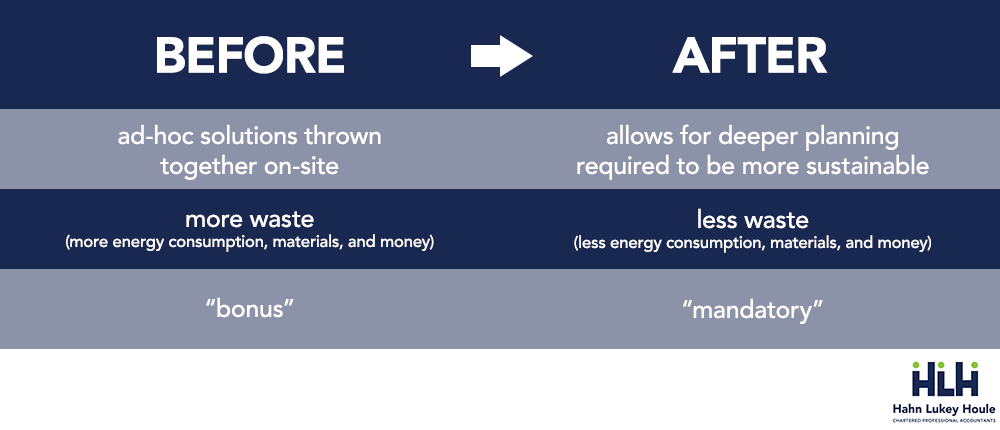
Prefabbing doesn’t rely on ad-hoc solutions thrown together on-site. It allows for the deeper planning required to utilize more energy-efficient and recycled materials. The higher initial cost of these materials is rapidly offset by your ability to add long-term value to your project with them (not to mention increase your business’ “green” reputation overall).
Prefabrication is neither fad nor theory. Popularized out of necessity after the 2009/10 recession, it’s become standard practise for savvy firms hustling to get ahead. Like all innovations that are absorbed into an industry, it’s quickly moving from “bonus” to “mandatory” in order to maintain solid profitability.

Fortunately for you, by now, the kinks of prefabbing have been worked out. There are ample best practices for firms who are new to prefabrication to follow (or brush up on). When done strategically, it’s a tactic that works in a big way.
“However beautiful the strategy, you should occasionally look at the results.”
– Winston Churchill
A lot of us have attempted Process Improvement. The reality is that most of us have failed.
For the most part, we didn’t fail because we lacked the talent, the team, or the hunger. We failed because it fizzled out. We started out excited, with people pitching in ideas left and right, and then we got even more excited when the early wins start rolling in.
But, when the adrenaline of success wore off, the processes started slipping. Eventually, we stop following them, and all excitement melts away. Disillusionment sets in, and although no one officially calls the time of death, the initiative stalls and doesn’t restart.
Does this sound familiar? It should, because it happens to pretty much all businesses who attempt long term Process Improvement.
The mistake we make is not institutionalizing our Process Improvement ideas as they emerge.
How do you prevent your great ideas from dissipating? Here are the basics of how to institutionalize Process Improvement:
No idea can survive as an island. Here’s the life cycle that a failed idea for Process Improvement typically takes:

As exciting as they are, ideas are cheap. It’s how we sustain them that makes them valuable.
Once the new process improvement is agreed upon, Management’s responsibility is to align it with the business goals that guide the company daily. Doing that will assimilate it into the process framework of the company so that it stops becoming an additional task.
Eventually, stand-alone tasks are always left behind, no matter how profitable they once were.
This can get awkward. Someone contributes an idea and it’s a good one. The natural inclination is to “empower” that person to be its caretaker. That’s when good intentions lead to dead ends.
“Empowerment” becomes imprisonment when the idea’s creator becomes responsible for its implementation. It also guarantees that the idea, and any money it’s saving the company, will be quashed if any of the following happen:

And et cetera.
If you want a good idea to survive, it must evolve away from its creator and be assimilated into a business’s daily tasks. Of course the person should be recognized, and potentially rewarded, but don’t saddle an albatross around their necks because they stepped forward with initiative.
The processes in a business that truly endure, from daily mail pick up to how we organize files, are boring by nature. When a process becomes so ingrained in our habitual, daily routine that we barely think about it anymore, then it becomes truly sustainable.
Ideas need to start out exciting to get everyone on board. Visions of a slightly better profit margin needs to dance in our heads.
But, new ideas won’t stay exciting for long, and before the crash it’s up to you to make the initiative deliberately boring. Once you align it with published business goals, merge it into routine daily processes.
Make saving money part of your most boring daily routines. Institutionalizing process improvements is what will engrain the new processes into the culture.
When a process improvement is introduced, we all start out with the best of intentions. The key isn’t to stay excited about those great ideas—it’s to own them. Even after the novelty wears off.
“Ideas are easy. It’s the execution of the idea that really separates the sheep from the goats.”
– Sue Grafton
Where’s my cash?!
We’ve all had that moment while looking at the Balance Sheet or Cash Flow Report after a good quarter, thinking you’ll be flush with cash—then getting a big surprise.
So what happened? Over-inventory happened. Getting comfortable happened, and you froze your money.
Look around your office and ask yourself how much money is frozen in it. A couple grand of cash in your computer. Anywhere from a few hundred to a few thousand in your desk, depending on your taste.
Lean thinking isn’t about being comfortable. It’s about seeing your money frozen all around you and looking for ways to:
1) thaw it so you can use it and
2) freeze less moving forward.
This is public enemy #1, and a classic killer of businesses across industries. It’s borne, ironically, from optimism.
Business is growing, therefore we can sell more product, therefore we need more product to sell. That’s both the way our businesses grow, and the way our businesses paralyze themselves.
We want more than anything for our businesses to grow. We want it so much that we let our hopes and dreams cloud the real picture of what’s happening.
Whether you’re a manufacturer or a reseller, ask yourself this question when your revenue rises: is it a long term trend, or is it a fluke?
(Hint: when you ask the first 10 times, your sense of hope will answer for you. Keep asking until you can give yourself an answer based on figures, not figments.)
When you buy or produce a widget, you’re voluntarily freezing your money into it. The widget is actually an ice cube, and you can’t access the money chilled into it until a customer buys it. Buying = thawing, and then you can use the money again.
Follow the data. If your business is on a real growth trend, buy or ramp up accordingly. If it’s a fluke, you’re throwing wads of cash into the freezer.
When all your cash is frozen, you’re paralyzed. You lose flexibility in your business decisions, lose the ability to add capital or improvements, and you become desperate. You discount harder than you should have to just to get some liquidity back.
And that’s the business killing cycle.
If you’re not careful, it’s easy to freeze money in unrecoverable ways.
As an exercise, draw a line down the middle of the biggest white board you can find. On one side header write, “what my customers care about.” On the other side write, “what my customers do not care about.” It is exactly that simple.

Start writing down everything you spend money on. Your customers care about electricity because you can’t operate without it. Your customers do not care about your hockey tickets or new company iPhones. How many printers do you need in the office? What sort of decorations? What does the customer care about?
When it starts to feel uncomfortable, and you’re resisting putting things in the “don’t care” column because you’re afraid of losing them—keep going. That means you’re on the right track.
Remember, everything in the “don’t care” column is waste. You’re not freezing that money so much as burning it.
If you want to be a cash rich company, if you want to have the flexibility of being liquid, then you need to be brutal with waste. Only freeze the money that customers need you to freeze in order to give them what they care about.
Going forward, keep your findings in mind as you make new business purchases. Mentally place a purchase in the “care” or “don’t care” category before you pull out the credit card. Even if you still let a few “don’t care” purchases slide through (after all, you’re human), that extra filter can make the difference between staying cash liquid, or standing on thin ice.
Change can come slowly to an office. Processes get ingrained, habits form, and the pressures of doing extra—on top of a long list of daily tasks—can quickly quell cooperation.
Process Improvement can change the bottom line, but it needs to be systemic. Change that’s top-down tends to make deep changes that aren’t sustainable and fall apart when the momentum wears off. Morale often falls apart shortly thereafter.
System-wide change is bottom-up. It’s about everyone sharing the same vision and being committed to incremental change that is, above all, sustainable. You can’t force that—it has to come from your internal Change Team.
Here’s how to build that team.

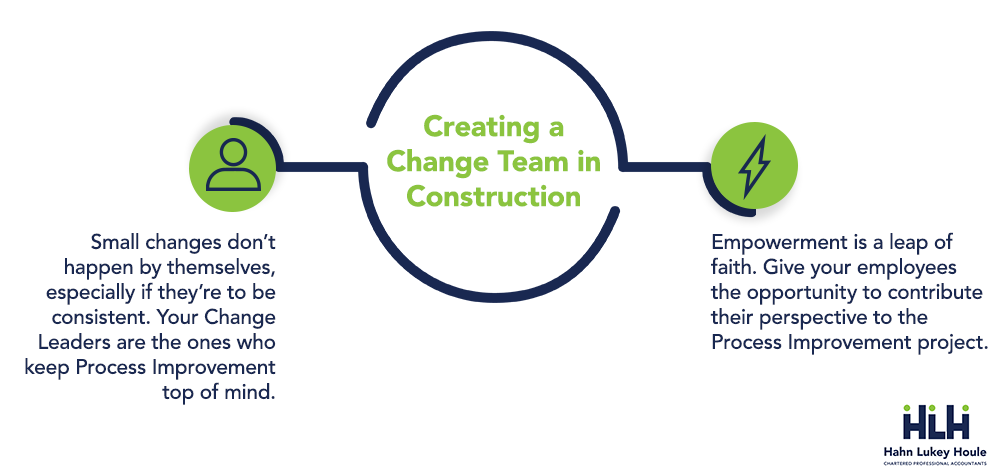
Small changes don’t happen by themselves, especially if they’re to be consistent. Your Change Leaders are the ones who, hour after hour, keep Process Improvement top of mind.
Your change team needs to be as all-in as you are. They need to be talking up the need to be nimble and efficient in the hallways, lunchrooms, and job sites.
But how will you find them?
Think of your existing staff. They drive your company and know its inner workings better than anyone.
Who are your most engaged employees? The ones already coming to you with ideas on how to do better. The ones who care, not because they have to, but because it’s their nature.
Start with them. Then let them inspire others to the challenge.
People have unique strengths. Embrace them. Here are the roles your Change Leaders need to fill. Put them into the roles they’re passionate about and they’ll bring their daily A-game.
Communicators: Don’t fool yourself – you’ll still have skeptics about this whole “Process Improvement thing” you’re up to. You need someone to not only share your vision, but articulate it with purpose when you’re not around.
Advocates: Your skeptics will say they’ve heard this all before and swear it’ll fizzle soon enough. Change Leaders will need to be consistent about why change is vital and how to make it happen. Ideally, you’ll have an advocate at every step of your process.
Liaisons: Sustainable change is organizational. It affects employees and customers alike. No one likes surprises in business, so each group needs to be advised and guided through what is happening and how it benefits everyone.
Coaches: Your team will need guidance and they’ll need to be challenged. Coaches do both. Coming from a peer, ongoing motivation is a powerful thing.
Resistance Managers: You’re going to get criticism. Rather than stifling it (which doesn’t end well), your Change Leaders can engage and respond constructively.
How many employees are driven every day to change your business for the better? How many are doing the bare minimum until the end of their shift? And how many are somewhere in the middle?
No one is going to be proactive about positive change unless you show them that the business is worth the investment of their energy. And that means investing in them first.
Empowerment is a leap of faith. You need to give your employees the opportunity to contribute their perspective to the Process Improvement project.
Not everyone will step up, and that’s normal. But give everyone the opportunity to be a part of a special initiative, and often your Change Team will come out of the woodwork organically.
“Change is the law of life and those who look only to the past or present are sure to miss the future.”
— John F Kennedy

Staying profitable in the construction industry is about being able to adapt to change. Projects overrun, site conditions change, regulations close in: the businesses that stay nimble stay prosperous.
Change management on a project-by-project scale is about building processes that both standardize best practices and anticipate changing conditions. Change management on a business-wide scale is no different.
To make your business more nimble and efficient, you need people to help you get there. You need a team dedicated to sustainable change.

Small changes don’t happen by themselves, especially if they’re to be consistent. Your Change Leaders are the ones who, hour after hour, keep Process Improvement top of mind.
Your change team needs to be as all-in as you are. They need to be talking up the need to be nimble and efficient in the hallways and lunchrooms and job sites.
But how to find them?
Think of your existing staff. They drive your company and know its inner workings better than anyone.
So think: Who are your most engaged employees? The ones already coming to you with ideas on how to do better. The ones who care, not because they have to, but because it’s their nature.
Start with them. And let them inspire others to the challenge.
People have unique strengths. Embrace them. Here are the roles your Change Leaders need to fill. Put them into the roles they’re passionate about and they’ll bring their daily A-game.
Communicators: Don’t fool yourself – you still have skeptics about this whole “Process Improvement thing” you’re up to. You need someone to not only share your vision, but articulate it with purpose when you’re not around.
Advocates: Your skeptics will say they’ve heard this all before and swear it’ll fizzle soon enough. Change Leaders will need to be consistent about why change is vital and how to make it happen. Ideally, you’ll have an advocate at every step of your process—from the office, to the floor, to the trucks.
Liaisons: Sustainable change is organizational. It affects employees and customers alike. No one likes surprises in business, so each group needs to be advised and guided through what is happening and how it benefits everyone.
Coaches: Your team will need guidance and they’ll need to be challenged. Coaches do both. Coming from a peer, ongoing motivation is a powerful thing.
Resistance Managers: You’re going to get criticism. Rather than stifling it (which doesn’t end well), your Change Leaders can engage and respond constructively.
How many employees are driven every day to change your business for the better? How many are doing the bare minimum until the end of their shift? And how many are somewhere in the middle?
No one is going to be proactive about positive change unless you show them that the business is worth the investment of their energy. And that means investing in them first.
Empowerment is a leap of faith. You need to give your employees the opportunity to contribute their perspective to the Process Improvement project.
Not everyone will step up, and that’s normal. But give everyone the opportunity to be a part of a special initiative, and often your Change Team will come out of the woodwork organically.
“Change is the law of life and those who look only to the past or present are sure to miss the future.”
— John F Kennedy