jrozak@hlhcpa.com
780 429 4403
“The longer the meeting, the less is accomplished.” – Tim Cook
Try this at your next meeting: look around the room and add up the hourly salary of each attendee in your head. If you don’t know, then ballpark it. Add about 25% for payroll extras.
Get an hourly figure in your head. Don’t be surprised if it flirts with four figures per hour for larger meetings. Add another 25% for prep, follow up, and loss of whatever productive momentum they have before the meeting that they’ll need to regenerate.
Bottom line: meetings are costly. And when they’re called over something trivial or spent hearing personal anecdotes, they can be painful.
You can’t run your business without them, but you can make them more cost-effective. Let’s talk about that.
These are quick, regular meetings designed to improve communication while cutting down on overall meeting times. Here’s how they work:
We at HLH have had a 15-minute standup meeting each and every day since 2016. These meetings start at 9:15 sharp, and they always follow the same format. We rotate the chair to include each and every employee, partner, and principal. Our agenda is straightforward; you can download our template here to use for your own standup meetings. The agenda has evolved a little over the years, but the meetings aren’t going anywhere—we love them!
Without an agenda, chaos will reign. Your focus will vary from meeting to meeting based on your business cycles, but a solid, reliable agenda will keep people on track.
Give it three basic parts:

Ensure everyone talks at least once, even if their comments are quick. Make it known that phones stay in pockets or at desks during these meetings. If these meetings are going to be effective, we need deep focus.
While you don’t need a chairperson barking Robert’s Rules, you should have 1 person delegated to keep attendees on-track and on-topic. If a manager starts to wander into political musings or vaguely related personal anecdotes, this person will firmly but politely move the meeting forward.
You should have an agenda that’s hard to get through in 15 minutes. That will help keep the urgency of rhythm.
Make sure the taskmaster is someone who is not only time-efficient but also respected by the attendees. The last thing you need is for these meetings to breed resentment.
Meetings are effective when the most attendees are engaged for the most amount of time. Make sure topics are relevant for everyone.
If an attendee raises a topic that relates to only one or two others in the room, acknowledge it and carve space for the involved parties to discuss further after the meeting. If you let them spend five minutes resolving, you’ve lost both time and focus from the others.
You probably have people working from home. Your 15-minute stand-ups are vital for remote workers because feeling integrated is such a challenge.
Don’t just put them on speaker where everyone forgets about them. Get a screen on a stand so everyone can see their video feed. If it’s audio-only, they’ll stay in their bathrobe and tune out. It’s a workday, so motivate them to look the part and come prepared to see their peers.
If morning meetings are part of your regular routine, check to make sure they’re still working how they should. If not, now is an ideal time to build a space where your team can come together to improve the day-to-day processes that help keep your lights on.
“It’s about making choices. Some are easy. Some are hard. And some will make you question everything.” – Tim Cook
With COVID-19 circulating freely, many of us have felt the sting directly in our staffing levels already. Those who haven’t should expect it this winter. There’s a vaccine on the horizon, but months of escalating numbers to endure before that.
You need to be prepared to keep your businesses running as more staff go into isolation than ever before. You’ve probably built a Business Continuity plan already, even if informally, but is it aggressive enough to get you through the next few months?
Here’s how to take your Business Continuity planning to the next level and make sure that the winter of 20/21 doesn’t force your business to a standstill.
Cross-TrainingYou hire people for certain skills, and the better they are at those skills, the harder it is to cross-train others to step in. That being said, keeping your business running is going to involve a little triage of your team’s essential skills.
Even your most specialized employees aren’t using specialized skills all the time. Chances are that another employee who uses similar processes could step in with minimal training. Go through your roster of key employees and identify who else on your team shares core competencies—or at least the ones that you can’t live without. Making these matches will help you maintain the bulk of employee operations should anyone need to isolate.
By now, the people who fit easily into the remote work paradigm have already made the leap and are already set up in their living rooms. Or, depending on your business, perhaps they’ve already done their stint at home and have since returned to the office. But what about the people who don’t seem to fit into remote work.
You may have employees who seem too tied-in with their teams or in-house systems to be able to work from home. However, while it’s possible some tasks need to be done in your facility, chances are that the majority of what they do can be remote.
This doesn’t mean that you need to send them home. It means that you prep them for remote work so, should they need to isolate, you can make it happen seamlessly. There will be some disruption by having them out of the office, but the diligence beforehand will minimize the disturbance. Prepare them for the possibility of remote work by:
Business survival is about liquidity. For those businesses who have already eaten their reserves (and, sadly, there are many), the last bastion of liquidity is your customers.
Whether they’re overdue by a day or a month, get on the phone with them. Skip the emails—they’re too easy to ignore. You have a relationship with them and this is the time to level with them person-to-person about the need to pay their bill on time.

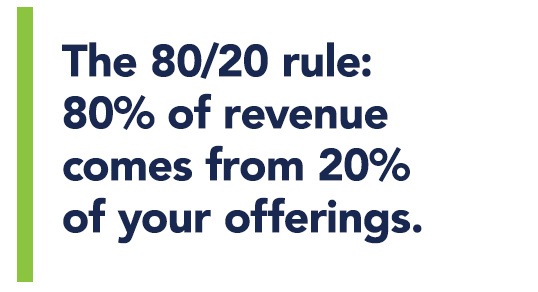
We follow the 80/20 rule: 80% of revenue comes from 20% of your offerings. If your business has to contract due to staff shortages, the 20% is your “Alamo.” Those are the services and products that tend to be in the center of your wheelhouse and which the most amount of staff can fulfill (the other 80% tend to be specialized to a few people).
Identify this all-important 20% of your offerings now so that if you lose enough staff that you need to cut back services, you can do so in a tactical and controlled way without chomping into your bread and butter.
We’re all waiting with bated breath for this seemingly endless storm to be over. However, scientific innovation is giving us a light at the end of a long tunnel. While the ride is far from over, let’s allow these breakthroughs to act as a source of optimism and a reason to keep a firm grip on the steering wheel.
Is your office feeling a little sparse lately? A lot of business people are finding themselves standing in the middle of empty desks, sometimes row upon row, while their intended occupants are working from their kitchen tables.
While the work is getting done elsewhere, you’re still paying for this space. Is there a better way to use it?
Remote work has been a slow-burn trend for years, and the pandemic has poured gasoline on it. A massive percentage of professional people will be working from home for the foreseeable future. But in the process of exploding remote work, COVID-19 has also revealed some of its fatal flaws. The pandemic has demonstrated that, while that office space might change, office workplaces are here to stay.
Not every team can effectively collaborate from home. Training is difficult, and there’s little of the office camaraderie that comes from daily familiarity. Furthermore, anyone who has been to a virtual conference or trade show knows how useful they are (or, rather, aren’t).
The office workplace is far from extinct, but how we think about our space is changing in the short term—and perhaps in the long term, as well.
Recent decades have seen a trend, largely driven by the tech industry, away from the segmented office style towards open concept spaces where people can collaborate freely. With the focus on teamwork, sharing, and public spaces, this has also allowed for a more densely-packed workplace.
The bad news for those with an open concept office is that you’ve probably had a steeper adaptation curve of cleaning and distancing than the cubicle guys. The good news is that you have many more options in terms of how you can use those big empty spaces.
Working from home trades perceived safety for the ability to work together face-to-face. Those returning to the office may be looking to get some of that in-person interaction back.

Multipurpose areas can build morale, facilitate higher quality work via collaboration, and inject dynamism into the office place. You have the space and creating more of these areas can pay off nicely.
Move some desks, clear a larger space, and create a multipurpose area for safe collaboration. Done right, it could be a guest speaking area, an open-air boardroom, or a training hub.
To ensure your team is comfortable using the space, make communal surfaces as minimal and simple as possible for easy wiping. Space chairs out for distancing or, even better, skip the chairs and use this as an opportunity to embrace stand up meetings.
The future of the office is flexibility. Many employees will return looking to scratch their social and collaborative itch but will still want the convenience of working from home. Build that option into your workplace.
“Hot desks” are shared workspaces wherein 2 or 3 people can use it when they’re in the office. While publicly touched surfaces are a no-go, offer the empty desk only and require use of their laptop from home. Ensure they wipe down the work space each evening.
Setting this up could open up workplaces reliably for the long term and allow you to create more permanent multipurpose areas.
This is more a question of financials than personnel. If revenue won’t be flowing again for the foreseeable future, two main options are:

If you’re holding onto empty office space, with no immediate plans to use its full capacity, ask yourself if this has anything to do with pride or sentimentality. Now is the time to look inward and figure out what your business really needs. Talk to your team. If it’s time to let the space go, make the hard – but smart – choice together.
“Honesty is the first chapter in the book of wisdom.” – Thomas Jefferson
2020 has been a crucible for businesses of all sizes. Alberta businesses know that we’ve been among the hardest hit, with many facing a long winter on the brink of insolvency.
The Federal government has been coming to our aid with blunt, expensive tools meant to shore up balance sheets until the revenue returns.
There’s been an arsenal of relief measures, from the all-important CEWS to the RRRF, BCAP, CEBA, and CERS. There’s been bridge financing, interest-free loans, emergency credit, and support for Northern, Indigenous, and Black-owned businesses.
Chances are that you’ve benefitted or are befitting from one or more of these. They’ve been going on for months, and when a process happens for that long, we’re in danger of thinking of it as “baked in” to your everyday operations.
But here’s the difficult question of the day: Are you prepared for when the money tap turns off?
If a random stranger donates $10,000 to your business, you don’t blend it into your general revenue. You bracket it out as extraordinary income because it was a “one-off” and you can’t make reliable business decisions based on that.
Random strangers in Ottawa have been giving you gifts for months. They’re one-offs, and they’re recurring, and that makes them dangerous.
After many months, these funds will bake themselves into our business model if we’re not careful. It’s a psychological trick: when a process recurs, it doesn’t take long to assume it will continue to occur.

You can fight this creeping assumption by keeping extraordinary income where it belongs: outside your labour, overhead, or other “above the line” rows. If it becomes invisible and lost in other numbers, you’ll start to subconsciously let it affect your planning.
The brutal honesty comes when you sit down to plan how you’ll move forward once the money taps are off. Imagining our business – the one we’ve invested years of our mental and resource equity into – in mortal danger is one of the hardest things we can do. And government payments make it easier to keep looking the other way.
After all, the money is right there on the balance sheet.

As hard as it is, it’s vital to chart the financial future of your business with no government help. Go into your statements, grind your teeth, and remove all the government dollars. The revised bottom line will be what will happen when (not if) that money stops flowing.
Now is the time to make the decisions that need to happen to make your business independently sustainable in the long term. Find the waste, rework the business model, make the needed cuts. Once you do that, you’ll sleep better at night knowing that, even if your business looks different than it did a year ago, you control your own financial destiny.