Lean vs. Process Improvement: What’s the Difference?

Lean vs. Process Improvement: What’s the Difference?

The terms “Lean” and “Process Improvement” aren’t interchangeable. In fact, while they both seek bottom line savings, that’s where the similarities end. 

Here are some very broad strokes of what defines these tactics in relation to each other. Bottom line: their approaches feed off each other, and you’ll get better results with an integrated approach than a focus on one or the other.


Lean

This is the adaptable orthodoxy that started in manufacturing and has spread across industries. Its core focus is eliminating Kaizen (waste). 

Lean is an umbrella term for approaches to both cutting waste and (especially with manufacturing) increasing productivity.

Top-Down Approach

Eliminating waste is usually uncomfortable for front line workers. As such, the decision to “go lean” usually comes down from the corner office. 

If you’re a boss contemplating Lean, proceed with caution. It’s tempting (and easy) to cut waste by reducing staffing levels. You’ll get a short-lived bump to the bottom line and, for the next month or so, everything is roses.

But a top-down only approach is fraught with danger. Overworked staff will take unsafe short-cuts, grumble, break down morale, call in sick more often, and erode that cost savings in a host of other ways. 

Before you know it, you’re losing more money than you saved, and your staff are now resistant to Lean in general.

lean vs process improvement comparison table

Process Improvement

While Lean is a methodology, Process Improvement is a tactic. 

This focuses on the countless processes that happen daily in your business. It’s a proactive approach that investigates existing processes and improves upon them, often incrementally, in order to build efficiencies. 

When a process improvement is introduced, we all start out with the best of intentions. The key isn’t to stay excited about those great ideas—it’s to own them. Even after the novelty wears off.

Grassroots

You can’t improve processes without constant dialogue with the people who understand them best. That’s why the first step to Process Improvement is to get out of the office and onto the shop floor, to the front desk, or to the sites and ask your team what’s bugging them about how they do their jobs. 

This is grassroots. It’s listening to your staff about incremental, sustainable improvements. These aren’t the big cuts that come from staff changes; they’re small and meant to accumulate over time.

The side benefits of Process Improvement, which are often as valuable (or more) than the savings, are increased staff morale and engagement, as well as what you’ll learn from becoming more active in the trenches.

But this approach, done solo, is also dangerous. If the changes are all happening in a grassroots, decentralized way, they could end up actually adding costs to the bottom line. That’s why the “Lean big brother” needs to be monitoring and making the real financial decisions.


Better Together

Lean is a methodology of cutting waste with decisions coming from the boardroom. Process Improvement is a tactic of learning about how to make processes more efficient by talking to front line staff.

If cost savings were the diamond in the middle, these two are looking at it from totally different angles—but the common goal means they can work together to reduce waste without sacrificing morale, and improve processes without increasing costs.


“If you define the problem correctly, you almost have the solution.”

Steve Jobs

Office Bottleneck? It Might Be You.

Office Bottleneck? It Might Be You.

office bottlenecks headerRunning an office is a gauntlet of processes that happen every minute of every day. Making coffee. Approving budgets. Putting callers on hold. There are some processes you think about, but most happen on autopilot. They flow and overlap throughout the day like a current.

But what happens when one process stops the current like a rock in the stream?  Or when multiple currents converge into one, slowing all subsequent processes to a crawl?  It’s a bottleneck, and it eats at profit like crazy.

Like all Process Improvement, getting brutal with bottlenecks requires identifying them first. That’s tough, and here are some reasons why:

  • Few businesses take the time to visualize the flow of their processes.
  • The bottleneck is probably invisible, in that it’s been “baked-in” over time to how your business works.


Process Bottleneck

The typical example of process bottlenecks is the “jam factory” allegory. Three conveyor belts with jars ready to be boxed converge toward one poor packaging employee—and they can’t keep up. There’s an obvious solution to this bottleneck. Hire another employee; fixed.

jam factory bottleneck example

That’s the easiest kind of bottleneck to smooth out. Naturally, those bottlenecks tend to be cleared up quickly. Want to find out about the ones that don’t get cleared up? Check that stack of papers on the corner of your desk.

No matter how much we delegate, the boss or manager is still going to be integrated into many processes. Often it’s just to approve the purchase/hire/work order/etc. That’s fine—until waiting for approvals becomes a problem.

It’s common for the costliest bottleneck to happen in the corner office, where a boss with a lot on their plate doesn’t approve or review in a timely way. Worse is that people often won’t speak up because—well, you know.


Delegations

Ironically, bottlenecks often happen when the boss is trying to be lean by saving money. Are these thoughts familiar:

“I don’t need to train anyone for that, I can do it!“

Or, “I need to cut middle management—send it to my desk.” 

Having a lean workforce saves money until bottlenecks happen. And that’s usually because, by reducing that “middle-management” layer, things pile up on the bosses desk and money is wasted. Meanwhile, employees wait in the wings and twiddle their thumbs.

Delegating is powerful, and can be an integral part of Process Improvement even if it doesn’t feel like it at the time. It’s about reducing bottlenecks (and increasing morale) via empowerment. 

And that brings me to Kanban, the best weapon we have against bottlenecks.


Kanban Solution

If the bottleneck is baked-in, then it has become invisible. That means tolerating its profit-sucking existence is part of your daily routine. 

If that hits home, you need to change how you see your routines. Kanban is the elegantly simple tool for that.

The Japanese word loosely translates to “card you can see.” Kanban is about visualizing process flows in simple ways in order to identify the bottlenecks.

Here’s how:

  • Lay out your Kanban on a good sized whiteboard. Identify one vertical column for each step in your process. Horizontal rows (“swimlanes”) will be for workflows moving through the process.
  • Buy a stack of pretty Post-it notes and stick on one for each new workflow that needs to move through the processes.
  • Watch for steps where the Post-its accumulate. That’s your bottleneck.

Be consistent. While it may seem childish in the beginning, Kanban will quickly uncover inefficiencies that you either didn’t think existed or had learned to ignore. 

Put the board in the center of the office where everyone sees it. And if the “Boss’s Review” column is the one always loaded with Post-its, be prepared to make the changes that you need. 


When unaddressed, bottlenecks have another cost: employee morale. Chances are, if there’s a bottleneck somewhere down the line, there’s a frustrated person or team trying to squeeze through. The sooner you address your bottlenecks, the sooner you’ll restore a healthy sense of flow throughout your business.


“In most organizations, the bottleneck is at the top of the bottle.”

– Peter Drucker

Where Are Your Manufacturing Bottlenecks?

Manufacturing a product, whether that’s a pick-up truck or a bar of soap, is a current of processes that happen one after the other. Ideally, the current flows like electricity.

But what happens when one step stops the current? Or when multiple currents converge into one, slowing all subsequent processes to a crawl? It’s a bottleneck, and it eats at profit like crazy.

Like all Process Improvement, getting brutal with bottlenecks requires identifying them first. That’s tough, and here are two reasons why:

  • Few businesses take the time to visualize the flow of their processes.
  • The bottleneck is probably invisible, in that it’s been “baked-in” over time to how your business works.


Process Bottleneck

The obvious example is the “jam factory”. Three conveyor belts with jars ready to be boxed converge toward one poor packaging employee—and they can’t keep up. Hire another employee: fixed.

jam factory bottleneck example

That’s the easy and obvious one, so those bottlenecks tend to be cleared up quickly. But, want to know about the bottlenecks that don’t get cleared up? Check that stack of papers on the corner of your desk.

No matter how much we delegate, the boss or manager is still going to be integrated into many processes. Often, it’s just to approve the purchase/hire/work order/etc. That’s fine, until waiting for approvals becomes a problem.

It’s common for the costliest bottleneck to happen in the corner office, where a boss with a lot on their plate doesn’t approve or review in a timely way. What’s worse is that people often won’t speak up because—well, you know…


Resource Bottleneck

Manufacturing is about assembling or manipulating raw materials into a saleable product. You need a smooth inward flow, and that’s harder than it sounds.

You have suppliers who must provide on time. You need freight logistics, whether that’s Canada Post or train cars, to get materials to you. And you’ll have to stop work if supplies run out, warehouse if materials overflow, and there are deadly wastes associated with both.

To pinpoint resource bottlenecks, map each step and shipment and see how long the journey is from supplier to finished product. Even 5% of raw materials tucked into a warehouse corner somewhere will devour your bottom line.

And that brings me to Kanban, the best weapon we have against bottlenecks.


Kanban Solution

If the bottleneck is baked-in, then it has become invisible. That means tolerating its profit-sucking existence is your daily routine.

If that hits home, you need to change how you see your routines. Enter Kanban: the elegantly simple tool for that.

The Japanese word loosely translates to “card you can see.” Kanban is about visualizing process flows in simple ways to identify the bottlenecks.

kanban board

Here’s how:

  • Lay out your Kanban on a good sized white board. Identify one vertical column for each step in your process. Horizontal rows (“swimlanes”) will be for workflows moving through the process.
  • Buy a stack of pretty Post-it notes and stick on one for each new workflow that needs to move through the processes.
  • Watch for steps where the Post-its accumulate. That’s your bottleneck.

Be consistent. What may feel childish to start will quickly disclose inefficiencies that you either didn’t think existed or had learned to ignore. 

Put the board in the center of the office where everyone sees it. And if the “Boss’s Review” column is the one always loaded with Post-its, be prepared to make the changes that you need. 


When unaddressed, bottlenecks have another cost: employee morale. Chances are, if there’s a bottleneck somewhere down the line, there’s a frustrated person or team trying to squeeze through. The sooner you address your bottlenecks, the sooner you’ll restore a healthy sense of flow within your business.


“In most organizations, the bottleneck is at the top of the bottle.”

– Peter Drucker

Prefabrication and Real Construction Savings

Prefabrication and Real Construction Savings

prefab real savings headerIn construction, as in warfare, success hinges on logistics. Project Managers need to juggle not only people and supplies, but also the needs of independent contractors and clients. Add in layers of compliance and safety checks, plus the wildcard of weather, and suddenly “lean methodology” seems downright abstract when it butts heads with on-site realities.

Today, we’re taking a break from theory and talking about a lean tactic that works. Prefabrication is an elegantly simple answer applied to an age-old problem: how to streamline on-site construction of necessary components.

Here are the basics:


Efficiency

You’re building a walk-up apartment building. Each unit requires plumbing, ventilation, and a host of other “behind the scenes” work. The plumbing for each unit is also approximately the same.

Traditionally,  bringing the plumbers out for however many trips were needed was an extra layer of coordination and expense. They had to bring out the materials, go back for more, liaison with other trades, etc.

So why not centralize? Having all the materials in one place means less time wasted travelling and buzzing around a crowded construction site.

Being able to do most of the work ahead of time means that the drywallers aren’t twiddling their thumbs and waiting. When the units are ready to be plumbed, the units are brought over, secured, and onto the next step.


efficiency before and after

Safety

We do our best, but even the most controlled worksite is a gauntlet of objective hazards. Every additional variable we introduce, including the parade of independent contractors with their own timelines and agendas, complicates safety.

Prefab happens in controlled environments. In a warehouse, there’s far less falling debris, or random nails, or rainstorms than on-site. 

Improving safety is one of the leanest things a construction firm can do. Besides the obvious improvement to worker well-being and morale, it notches down insurance costs and elevates your company’s reputation, which leads to smoother hiring. 


safety before and after

Sustainability

Being environmentally friendly isn’t a feel-good exercise. Kaizen’s central tenant is reducing waste. Saving waste = less energy consumption, fewer materials, and ultimately fewer dollars flushed away.

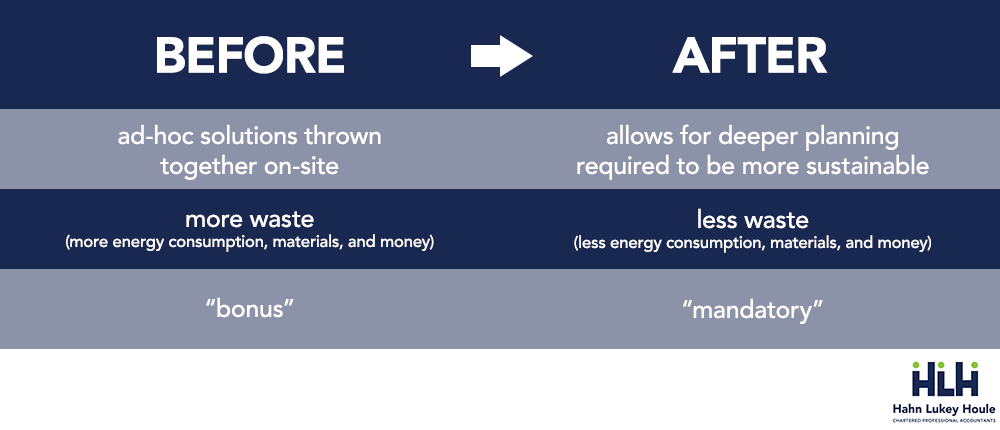
Prefabbing doesn’t rely on ad-hoc solutions thrown together on-site. It allows for the deeper planning required to utilize more energy-efficient and recycled materials. The higher initial cost of these materials is rapidly offset by your ability to add long-term value to your project with them (not to mention increase your business’ “green” reputation overall). 

Prefabrication is neither fad nor theory. Popularized out of necessity after the 2009/10 recession, it’s become standard practise for savvy firms hustling to get ahead. Like all innovations that are absorbed into an industry, it’s quickly moving from “bonus” to “mandatory” in order to maintain solid profitability. 


sustainability before and after

Fortunately for you, by now, the kinks of prefabbing have been worked out. There are ample best practices for firms who are new to prefabrication to follow (or brush up on). When done strategically, it’s a tactic that works in a big way.


“However beautiful the strategy, you should occasionally look at the results.”

– Winston Churchill

How to Keep Good Ideas Alive (and Save Your Money)

How to Keep Good Ideas Alive (and Save Your Money)

keep good ideas alive save money hlh edmonton A lot of us have attempted Process Improvement. The reality is that most of us have failed. 

For the most part, we didn’t fail because we lacked the talent, the team, or the hunger. We failed because it fizzled out. We started out excited, with people pitching in ideas left and right, and then we got even more excited when the early wins start rolling in.

But, when the adrenaline of success wore off, the processes started slipping. Eventually, we stop following them, and all excitement melts away. Disillusionment sets in, and although no one officially calls the time of death, the initiative stalls and doesn’t restart.

Does this sound familiar?  It should, because it happens to pretty much all businesses who attempt long term Process Improvement.

The mistake we make is not institutionalizing our Process Improvement ideas as they emerge. 

How do you prevent your great ideas from dissipating? Here are the basics of how to institutionalize Process Improvement:  


Align the Idea with your Business Goals

No idea can survive as an island. Here’s the life cycle that a failed idea for Process Improvement typically takes:

failed idea life cycle hlh edmonton

As exciting as they are, ideas are cheap. It’s how we sustain them that makes them valuable.

Once the new process improvement is agreed upon, Management’s responsibility is to align it with the business goals that guide the company daily. Doing that will assimilate it into the process framework of the company so that it stops becoming an additional task.

Eventually, stand-alone tasks are always left behind, no matter how profitable they once were.


Get the Idea Away from its Creator

This can get awkward. Someone contributes an idea and it’s a good one. The natural inclination is to “empower” that person to be its caretaker. That’s when good intentions lead to dead ends.

“Empowerment” becomes imprisonment when the idea’s creator becomes responsible for its implementation. It also guarantees that the idea, and any money it’s saving the company, will be quashed if any of the following happen:


empowerment becomes imprisonment hlh edmonton

And et cetera. 

If you want a good idea to survive, it must evolve away from its creator and be assimilated into a business’s daily tasks. Of course the person should be recognized, and potentially rewarded, but don’t saddle an albatross around their necks because they stepped forward with initiative. 


Make it Boring

The processes in a business that truly endure, from daily mail pick up to how we organize files, are boring by nature. When a process becomes so ingrained in our habitual, daily routine that we barely think about it anymore, then it becomes truly sustainable. 

Ideas need to start out exciting to get everyone on board. Visions of a slightly better profit margin needs to dance in our heads. 

But, new ideas won’t stay exciting for long, and before the crash it’s up to you to make the initiative deliberately boring. Once you align it with published business goals, merge it into routine daily processes.

Make saving money part of your most boring daily routines. Institutionalizing process improvements is what will engrain the new processes into the culture.


When a process improvement is introduced, we all start out with the best of intentions. The key isn’t to stay excited about those great ideas—it’s to own them. Even after the novelty wears off.


“Ideas are easy. It’s the execution of the idea that really separates the sheep from the goats.”

Sue Grafton

Water and Productivity

Water and Productivity

How much water do we really need?:

No, you don’t need to count 8 glasses of water a day. But your body, your attitude, and your bank account will thank you for drinking more. Here are the numbers:

  • Men: about 15.5 cups (3.7 litres) daily
  • Women: about 11.5 cups (2.7 litres) daily

Business man with headache - dehydration

That sounds like a lot, but it’s not just straight water. About 20% comes from food, and more comes from other drinks. Everything in our body needs a constant supply of water to function efficiently. Deny your tissues enough water, and dehydration sets in. Getting thirsty happens after you’ve gotten dehydrated, and the dreaded headache after that. Dehydration affects our mood, outlook, and productivity level. If you can’t afford to waste time in your job, then you can’t afford to be dehydrated.

Science Says So:

A 2013 study at the University of London wanted to quantify if water makes us more productive. So:

  • 34 people in Group A ate a plain breakfast with no water
  • 34 people in Group B ate breakfast with water after

Both groups were asked to perform simple tasks, and Group B performed 14% better than Group A. In the world of business, 14% is a big margin. They tried it another way. Researchers asked teens to ride bicycles for an hour and half in heavy clothing. The exertion actually shrunk their brains to the equivalent of aging 1 year. After drinking water, the shrinkage reversed.

People drinking water in Business Office

How drinking water makes us more money:

Without water, your blood can’t carry enough oxygen to your brain. Losing as much as 2% of your body’s water can kill your motivation, spike your fatigue, and make everything just a little more stressful. Your brain function suffers at the very beginning of dehydration; well before you even feel thirsty let alone get a headache. Your business won’t perform at its best if you don’t, so drink up.

How do we drink enough water:

First we need to know how much we need. There’s a formula: divide your weight (in pounds) in 2 and that’s how many ounces you need. So a 200 pound man needs 100 ounces or about 3 litres a day. And no, you shouldn’t guzzle it all at once.

We’re just not going to remember to go to the water cooler that many times (and we’re normally shushing our employees away from there, anyway). Here’s a hack: include drinking a glass of water in your daily routines.

  • When you brush your teeth: have a glass
  • Before you have supper: have a glass
  • Before you turn on Netflix when you should be catching up on paperwork: have a glass

This will turn drinking water regularly into a habit. It will get you to your daily intake and get your brain at peak performance where it needs to be.

It’s your job to build your business. Don’t deny yourself the mental function to do that to the best of your ability.