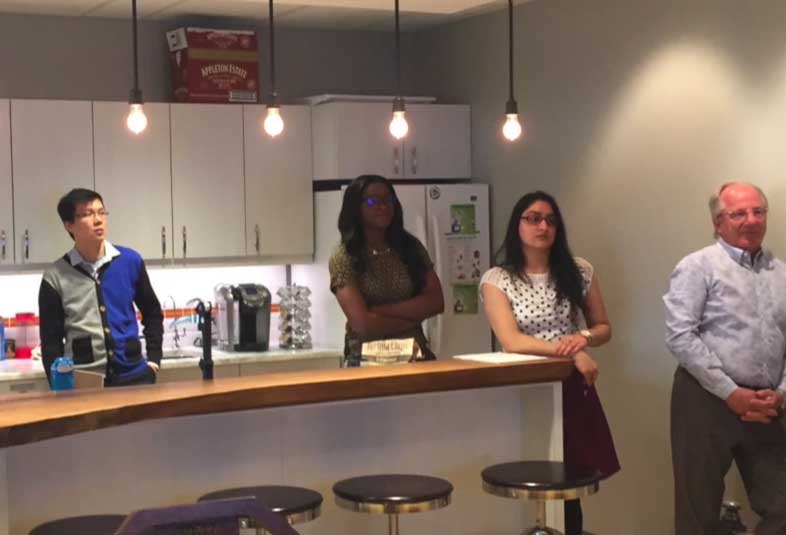
by The HLH Team
3 Takeaways:
1. Daily morning meetings increase communication and efficiency
2. Adapt our agenda to suit your business
3. It will be awkward at first but be consistent
Communication is key to relationships. That applies to our professional life, too. Most companies expect all their employees to be on the same page without providing a vehicle for effective communication.
Paul Akers, author of the succinct and seminal “2-Second Lean,” turned the abstract notion of a morning meeting into an actionable tool for businesses. I’m going to tell you how we adapted his model to our business, in the hopes that you adapt our model to yours.
How HLH Does It:
We’ve been doing the morning “drum beat” for over a year. Its evolved into a pivotal part of our office day, and happens every morning at 9:15 no matter who is or isn’t there. Team members take turns leading the meeting (with the schedule posted well in advance). Rotating the leader, which effectively puts that person on the spot, often has the extra benefit of highlighting personal strengths that we didn’t know he or she had before.
It’s standing-only and no longer than 15 minutes. There’s a quick pace so it’s crucial to stay succinct and on topic. Here’s what we talk about:
Our Agenda:
1) Wins/ News/ Things to Celebrate:
A morale builder that wakes people up! Must be kept snappy and no rambling.
2) Partners’ Calendars – due dates and pinch points:
This is anything from the last 24 hours that demands our attention. It’s improved client-services and has made us a more effective rapid-reaction team.
3) Workflow Whiteboard:
Our whiteboard is the office’s visual hub and a pivotal driver for our Process Improvement. More about it here: https://hlhcpa.com/video-resources/
4) Education:
If you’re not constantly learning, you’re falling behind. The daily meeting leader is responsible for an education piece. Whether it’s about the 8 Wastes, a Ted Talk video or demoing new software is up to him or her. This is where our team’s creativity shines through.
5) Continuous Improvement:
Continuous Improvement is about the big impact of small changes adding up over time. A morning meeting is the perfect vehicle for it. Each day, we zero in on one department and ask the relevant person, “what’s bugging you in your department.” “Bugging” is the smoke; that’s what we look for to track the waste down.
We also review improvements made from previous meetings and check in on other ideas people might bring forward.
6) Word of the Day:
Try to end on a light note. The daily meeting leader brings this forward, and while it’s often a term related to the education piece (ex. 5S), it can also just be for fun (did you know “cackleberry” is another word for “egg”?)
View/download a PDF of our morning meeting outline here: Morning Meeting PDF
What to Expect:
 I chatted with Richard Houle about this. He reminded me to add the caveat that the first month or two will be awkward. New habits always are, especially if your team is acclimatized to walking in every morning, saying “hi” and going to sit in their office or cubicle. You’ve gotta work past it, and reassure your team that they’re doing it right when they start to have doubts. After a couple months, the meeting will become indispensable to keeping your team in sync and ruthless about eliminating waste. Richard noted that when a project or problem emerges, the open communication exists for team members to pull together and get it done faster.
Make it Work for Your Business:
We’ve adapted it for HLH, and we love it. For it to work, you need to adapt it to your business. I encourage you to Google “2 second lean morning meeting” and watch how Paul Akers does it, as well. Steal our agenda and adapt it to what your company needs. If a new team member joins, use the meetings as a chance to teach him or her about your company culture. If a major problem arises, channel the team’s collective energy not proactively confront it.

by The HLH Team
Let’s make this personal. Where is the most amazing place you’ve ever been, a place that took your breath away? Was it a glacier clad mountaintop, a steamy jungle or remote cliff overlooking endless ocean? Take a second and capture the image, feeling, and memory in your head.
Now: write me an email describing that place. Don’t make it too long because I’m a busy man. In a few sentences, make me breathless. Tough to do isn’t it? Now let’s replace “place” with “vision.” We all have visions for our businesses, places we want to be in a year or 5. It’s probably as clear as day in your head, and I’ll bet it’s spectacular. You’ve probably tried telling your staff about your vision. After all, if they are on board it has a lot better chance of happening. But your staff haven’t been getting on board. They just haven’t been getting it. And without sharing the vision, how can you properly manage change in order to get there?
Stop Telling, Start Demonstrating
 The solution? Stop trying to show them the picture. You can’t explain your most amazing place to me, so how can you explain your vision to them? You need to show them how the vision can happen, and how the change is going to benefit everybody.
The managers and owners who manage effective change are those who leave their office, stop sending emails and start showing their staff what change looks like. They start finding and eliminating waste, thinking of more efficient ways to perform their daily processes, and empower those around them to contribute. They’re in the trenches, on the factory floor and in the hallways coaching people, asking them about their ideas, and thinking about how to make things 1% better than they are now.
But How?
Effective change management is not about edicts and it doesn’t happen in a day or a week. It is about harnessing the power of your team to collectively push the company to its higher potential. Engrained mindsets have to topple and decades old ways of doing things have to change, and none of it can be forced or coerced.
Think of the receptionist who has always double entered her invoices to make sure they’re accurate. She’s been doing this since her kids were toddlers (they have their own kids now). She’s the ‘old-guard’, and her role in your vision is like a swing-state in a US election; you need to change her mind if you want your vision to succeed.
You can’t change the receptionist’s mind by telling her about your vision. Engage her at her desk (not sitting across from yours with you staring down at her). Talk to her about processes and how they could always be simplified. Ask her about her about the processes she uses and empower her to give you her ideas. Listen to her ideas and implement those that you can. Take the baby steps with her but she needs to cross the line towards change on her own.
That’s how to stop showing and start demonstrating.
Be Consistent
 If you don’t think that you have the time, energy and perseverance to see the change through, don’t start. Starting and failing, especially when it leaves others in the lurch, engrains current culture and makes it harder to change the next time. When you step up to manage change, you’re making yourself the most visible person in the office. You’re the only one who can make change happen, and the only one who can let it fail.
All eyes will be on you, and while this puts a lot of pressure on you, if you’re a consistent demonstrator of the change you want to bring about, you will be the one to take the next step into the future of your company.
Stay Tuned…
Over the next few months, we’ll be giving you tools, tips and inspiration for how to implement change management and what to expect along the way. We’re going to be giving practical advice, often based on our own successes and failures, as we’ve managed change from a lean perspective, improving processes and making our company more efficient as we go.

by The HLH Team
Over-Inventory is the king of the deadly wastes. It can be disastrously expensive as it ties up vital cash flows and potentially drives down the value of your product and, by extension, your brand.

Cost upon Cost
Producing inventory costs a lot of money. You need to buy the raw materials, get them shipped, hire and train staff, invest in equipment, and spend money on overhead. A useful exercise is to calculate how much money goes into each product that you make. Write it on a sticky note if you want and stick it right onto the product.
Whatever cost went into making the product equals how much cash has been frozen into it.
Until that product is sold, that cash is as good as gone. Until that product is sold, it will cost you to store it, every time you move it, to heat or cool it, and keep track of it.If the product doesn’t sell, you may need to discount it, which could potentially devalue your brand. If it sits there too long, it may go obsolete and become worth less than you’ve invested into it. If it gets damaged and you need to throw it away, the cost of doing that is an extra kick in the pants.

Close to the Rocks
Think of your inventory as water level in a bay, and your company as a ship. When the water rises, it lifts the ship with it and hides all the rocks and dangers that were visible during low water levels. Those rocks are the other deadly wastes; one of the worst things about over-inventory is that it hides many other wastes within it. It’s harder to identify wastes like defects and transportation with high inventory because they’re not as visible.
Staying close to the rocks means keeping the water level low. While sailing on the smooth open water of high inventory can be very comfortable, it will cost you dearly in the long run. Just-in-Time production, a hallmark of Lean methodology, is a radical shifting of production methods from company “pushed” to customer “pulled.”
In Lean, the apparatus of production is pointed at the customer, and shifts into gear when the customer places an order. While it may take time to implement, just-in-time will dramatically reduce over-inventory waste in the long run.

by The HLH Team
To run a business, at least part of you has to be an optimist. Bad times can always improve, and good times can always get even better. With that steadfast optimistic spirit, it’s normal to build our companies to be able to produce more than we’re currently selling so we have room to grow.
However, the ability to over-produce comes with the danger of producing too much.

Over-Production is the most feel-good of the 8 wastes. When we’re producing a lot, it feels like the good times are rolling. We have a nice cushion in case the orders start coming in and the stacks of products that are ready to sell gives us the welcome perception that our company is prospering, even if it’s not.
I’ve fallen victim to the indulgence of Over-Production. It’s nothing to be ashamed of; it means you think you have a great company. But it can become a very expensive indulgence if the expected orders do not materialize. That’s when the unsold product makes you feel ill instead of optimistic.
Pull not Push
Traditionally, companies have often operated on the principle of having products ready to go when the customer comes calling. While this is handy when the customers do come knocking, it’s also a gamble.
Lean methodology teaches us about “just in time” production, which operates on customer’s “pulling” production with their orders instead of the company “pushing” production with its optimism. Switching to a just in time approach is not easy, and often involves substantial changes to the production process, but for companies suffering from chronic over-production it’s well worth looking at.
It’s natural to assume that the larger the batch size, the cheaper the cost per unit.
That’s often, but not always true, especially when larger batch sizes lead to overproduction.
Companies that over-produce tend to tie up a lot of cash in unsold products, which reduces their liquidity and limits their ability to borrow money from the bank.
If your company requires periodic short term operating loans, this could be a serious problem.
It’s Not Just Manufacturing
Over-Production waste doesn’t just happen to manufacturers. Think of the last time you went into a meeting with 5-10 people coming and printed about a dozen handouts just to be on the safe side.

If you’re buying donuts for the staff, count the staff first. If you’re buying binders, check to see if you still have some first. Over-production sneaks into our lives in many ways, often disguised as the feeling of “covered all our bases.” The best way to fight this waste is to learn how to operate your business without a buffer of extra products. Staying close-to-the-rocks in terms of production can be uncomfortable at first, but in the long run, can reward us with less shrinkage and more cash flow.

by The HLH Team
In Deadly Waste lingo, “transportation” refers to the movement of materials and “motion” refers to the movement of people. My fingers are in motion right now, and when I print this off I’ll be in motion to the printer, which is 3 steps away. I bought it because I print a lot and the nearest printer was about 20 steps away. Printing documents meant changing rooms, being chatted at, and usually losing my focus by the time I sat back down.
Going to meetings can be a big waste of motion. While face to face meetings are important sometimes, sending our staff out on too many of them leads to excessive time in transit and waiting around in other workplaces. Before sending people out to meetings, think about if it’s necessary for them to go or if it can be done over video conferencing.
Everything Has a Home

5S in action: Trevor Lukey’s immaculate garage.
How much time do you waste looking for things? From staplers to front end loaders, if a piece of equipment is moved and not put back (or if it didn’t have a home in the first place), it leads to inevitable wasted motion and morale-killing frustration.
Have a home for commonly used items and make it clear to people that anyone who takes things must put it back. If someone uses an item a lot, consider getting them one of their own so that he or she always knows where it is.
Knowing where everything is includes you, too. When you leave the building, especially if you won’t be near your phone, tell someone central.
Running around looking for the boss is a frustrating endeavor that wastes time and energy.
If you want to delve deeper into workstation organization, research “5S” to learn more about how to keep the world around your workspace clean, clutter free, and organized.
Spaghetti Mapping
Grab a piece of paper; make it a big one. Sketch out your immediate work area, whether that’s an office or retail counter. Include as many places where you travel in an average day as possible.
Keep that paper nearby and, every time you go somewhere, draw a line. A line to the coffee machine, to the stockroom, to go find a hammer.
Using a wavy line for distances off the paper, draw all your workplace movements for the day.
Looking at your paper, ask yourself where you went the most. Could that trip be made a little shorter? Ask yourself which trips were useful and which weren’t.
Could that 10 minute hunt for the hammer have been avoided if the hammer had a proper home?