Lean Leadership in Professional Services

Lean Leadership in Professional Services

lean principles professional servicesWith a stack of files on your desk and 3 urgent calls gone unanswered, it’s easy to get lost in the day-to-day of managing a professional services firm. But to achieve process improvement that brings systemic change, we need to invest our leadership focus in the people who run our business everyday.


Inspiring Experts

To succeed in professional services, you surround yourself with experts. This can complicate what leadership looks like, and makes their buy-in absolutely essential.

Change Leaders need to articulate their vision clearly to themselves (don’t skip that part), and then to their team. But what about those who are comfortable just the way things are?

If you try to bully your expert team into change, it will taint the process from the beginning. When you encounter the “but we’ve always done it this way” crowd (often referred to as the old guard), you need to erode the resistance with your vision. Here’s how:

change in professional services


Communication

If you’re a quiet leader who likes to keep to yourself, that will need to change. Change Leadership is about building people, and that takes advanced communication skills. If you lack these, but want to become that leader, don’t be ashamed of reaching out to a professional coach or other mentor to help you.

When it comes to communication, office-based business have the advantages of being in close proximity where everyone (usually) starts work and has lunch at about the same times. Take advantage of this and get clear about what communication looks like in a change-driven office:

communication in professional services


Visualize It

Process improvement is about constant definition and measurement. People need to see where change is needed, what change is happening, and how successful change has been. And they need to see it in a glance.

Be transparent with your KPIs for file turnaround time, efficiency, etc. Buy a big whiteboard and track the course of each KPI daily. If a deliverable isn’t on target, there’s a reason. Professional teams need concise constructive feedback when they’re off-base, and be motivated to review processes, sniff out waste, and change the course.

Make the whiteboard democratic. Put it in the centre of the office (not in the boardroom) and provide post-it’s for ideas. Make it the hub of your daily stand-ups and keep it simple.


In professional services, everyone in the organization serves a critical purpose to keep the business running smoothly. When everyone in the firm feels valued and empowered to make an impact, they show up with their best ideas and contributions. Make your team feel like they have a stake in the success of the business, and you’ll be amazed at how much more can be accomplished with the same Lean team.


“The pessimist complains about the wind. The optimist expects it to change. The leader adjusts the sails.”

 John Maxwell

Lean Leadership in Construction

Lean Leadership in Construction

lean leadership in constructionConstruction is an industry of tight timelines beset by on-site realities. What’s planned on paper rarely materializes at site, and foremen need to adapt quickly to maintain margins.

Change leadership is about the leader inspiring his or her team to sniff out waste and destroy it. As leader, you can’t be on every site at all times, and you have a million things to worry about. It can’t be your job to make sure enough lumber has been brought in or to see if a bathroom pod can be pre-fabbed at the shop. You need empowered crew leaders.

It’s a cultural shift, and it’s neither easy nor fast. You’ll need to articulate a vision that inspires, be visible on site, and divert your focus from managing logistics to coaching your team.


Inspire Before Bulldoze

Change Leaders need to articulate their vision clearly to themselves (don’t skip that part), and then to their team. But what about those who are comfortable just the way things are?

if you bulldoze them with your vision, it taints the process from the beginning. When you encounter the “but we’ve always done it this way” crowd (often referred to as the old guard), you need to erode the resistance with your vision. Here’s how:

change leadership in manufacturing


Looking bigger picture, your construction firm is probably only one of many stakeholders on a large project, and it becomes more complicated when the “old guard” are other contractors.

Establish a culture of process improvement in your business first, and then (if you’re ambitious) you can begin to inspire other contractors that you commonly work with. It’s inspiring that some large projects are now entirely Lean, with contractors all working together towards a common goal that thrills the client and increases margin.


Communication

If you’re a quiet leader who likes to keep to yourself, that will need to change. Change Leadership is about building people, and that takes advanced communication skills. If you lack these, but want to become that leader, don’t be ashamed of reaching out to a professional coach or other mentor to help you.

communication change-driven construction


Delegation

Change Leadership begins with authentically asking your team for their ideas. But it goes on from there.

Ideas aren’t worth much without accountability-driven execution. You’ll be spending more of your time coaching and developing your team, but your other pressures aren’t taking a holiday.

Delegation is the natural evolution of empowerment. Invest in your team, build processes for them to execute their ideas, then learn to step back. Your stress level will decrease as your employees’ new responsibilities become routine, and their ideas become part of systemic change.


360 Reflection

Process improvement will wilt without reflection and measurement. In construction, waste is often lurking systemically in your processes. Root it out. Don’t let failed jobs accumulate because you didn’t get rid of process problems.

Be transparent with your KPIs for delivery, cost, safety, etc. Do a post-mortem for every job with your team and see how they did. Don’t let that conversation devolve into a finger-pointing session; keep it about constructive feedback for the last job and proactive action items for the next.

Start the whiteboard during the job, so that foreman and workers alike can post ideas that occur to them in real time. Make it easy to give criticism, especially if a job goes south and all we want to do is forget about it. As Seth Godin says more eloquently than I, failure is our best and perhaps only teacher.


It’s amazing what an empowered, engaged team can do. When Lean principles are properly applied, team members step up to the plate in ways you might not expect. When everyone on the crew feels a sense of ownership, it becomes everyone’s job to push projects into better, faster, more efficient territory. You’ll feel the difference when you arrive at work every day—and that’s the kind of culture that lays a solid foundation to build upon.


“The pessimist complains about the wind. The optimist expects it to change. The leader adjusts the sails.”

 John Maxwell

Lean Leadership in Manufacturing

Lean Leadership in Manufacturing

lean leadership in manufacturing


Manufacturing leadership can easily become about nothing but processes, logistics, safety, and efficiency. If it’s your daily routine to circulate from your office to the boardroom and back again, that needs to be disrupted.

Change Leadership requires the leader’s personal evolution from managing tasks to managing people. It’s a change of focus that needs to leap off the memos and into your routine.

Be more visible. Be seen on the shop floor and on the odd coffee break. Be the “good cop” sometimes, and ask about more than work. Get to know the people who are going to build your business.


Inspire People, Don’t Bulldoze

Change Leaders need to articulate their vision clearly to themselves (don’t skip that part), and then to their team. But what about those who are comfortable just the way things are?

If you bulldoze through them with your vision, it taints the process from the beginning. When you encounter the “but we’ve always done it this way” crowd (often referred to as the old guard), you need to use your vision to erode their resistance. Here’s how:

change leadership in manufacturing


Communication

If you’re a quiet leader who likes to keep to yourself, that will need to change. Change Leadership is about building people, and that takes advanced communication skills. If you lack these, but want to become that leader, there’s no harm in reaching out to a professional coach or other mentor to help you.

Here’s what communication looks like in a change-driven manufacturing business:

communication change-driven manufacturing


Delegation

Change Leadership begins with authentically asking your team for their ideas. But it goes on from there.

Ideas aren’t worth much without accountability driven execution. You’ll be spending more of your time coaching and developing your team, but your other pressure aren’t taking a holiday.

Delegation is the natural evolution of empowerment. Invest in your team, build processes for them to be able to execute their ideas, then learn to step back. Your stress level will decrease as your employees’ new responsibilities become routine, and their ideas become part of systemic change.


Visualize It

Process improvement is about constant definition and measurement. People need to see where change is needed, what change is happening, and how successful change has been. And they need to see it in a glance.

Be transparent with your KPIs for delivery, cost, safety, etc. Buy a big whiteboard and use it to track the course of each KPI daily. If delivery isn’t on target, there’s a reason. The team directly involved with transportation needs to know that, be motivated, and sniff out waste to change the course.

Make the whiteboard democratic. Put it in the centre of the office (not in the boardroom) and provide post-it’s for ideas. Make it the hub of your daily stand-ups and keep it simple.


A successful shift to Lean Leadership relies on making the transition feel natural to your team. Start small. Introduce the whiteboard, and invite people to use it as a team communication tool. Build trust by helping your team get to know you as well as you’d like to know them. Successful change is cumulative, so taking it one step at a time can help build a more cohesive team dynamic as you move forward.


“The pessimist complains about the wind. The optimist expects it to change. The leader adjusts the sails.”

 John Maxwell


8 deadly wastes seminar cta april 16


the winding path toward culture change cta april 18

Lean Principles to Lead Culture Process Involvement

Lean Principles to Lead Culture Process Involvement

Lean Principles


You look at your net profit and it’s not where it should be. You can feel the waste.

So you decide to take some action. You’ve heard about Process Improvement, possibly at an HLH seminar or read “2 Second Lean.” You talk to your core team and they’re on board.

Now there’s a fork in the road. We typically only see it through hindsight, but it’s there. There are 2 ways to implement change. Neither option is “wrong,” although one of them will impact that net profit more.


 Change Management

This is the kind of change that is planned, deliberate, and typically small. Here’s the process:

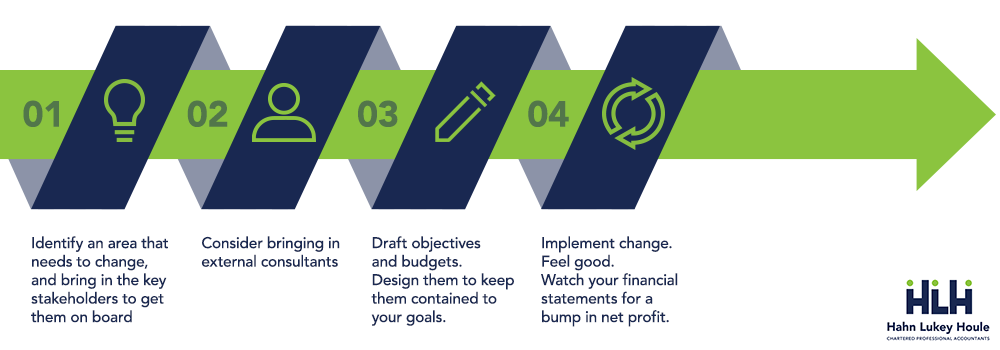
change management

You hope that the change will stick when the boardroom turns its focus to the next matter. It usually doesn’t. That’s because if change is driven by a formal plan, it will evaporate when the plan expires.

Change Management is often effective and it can save you money, especially if it’s consistent. It also allows the boardroom to retain control of the entire process in exchange for the process being limited to containable targets.


Change Leadership

This is the sort of change that focuses on a cultural shift over a plan. It’s about empowering your entire team (not just specific stakeholders) until they’re driven to deliver unpredictable, uncontrollable, paths to Process Improvement.

It’s like injecting your entire business with a sense of urgency. It can get out of hand, can drown you in multiple visions that often compete with each other, and is the only path to lasting, systemic change.

change leadership

Change Leadership turns your entire team into a collective engine for change. Don’t expect that engine to take you to predictable places. Guide it with your vision, and be open to the experience.


Questions Towards Leadership

Change Management empowers stakeholders to a degree, but it’s still driven and controlled by the boardroom. It’s an extension of standard management practices and mindset.

If you want to become a Change Leader, you must first trust your team. If you mistrust them to the point of micromanaging, it will be impossible to trust their new ideas to move you forward.

Articulating a vision to your team is different than emailing them exactly what the change process will look like. The latter is a to-do list, the former is an agent of inspiration.

To inspire them, you must have a clear vision. Here are a few questions to ask yourself as you move towards that:

four questions to change leadership

The more honestly you can answer those questions, the more urgency you’ll be able to spread across your business. Get inspired, inspire others, then let them flourish.

Systemic change can be planned in advance. It’s about creating a sense of urgency to drive forward unproven ideas. Your team members aren’t Change Consultants, so don’t expect polish. Polish is for small and temporary change; collective urgency is systemic and sustainable.


“Change your thoughts and you can change the world.”

 Norman Vincent Peale

8 deadly wastes seminar cta april 16


the winding path toward culture change cta april 18