Real and False Urgency in Construction

Real and False Urgency in Construction

real vs false urgency construction header

By definition, construction is a manual industry. It depends on people’s hands to do the work of bringing a blueprint to reality. And its success or failure is directly related to the level of urgency that those hands (and minds) have bought into.

Forcing a sense of urgency is a mistake. It creates pressure to act busier, which equates to working too fast, and results in unsafe work conditions and team burnout.

You can only build a healthy culture of urgency if you inspire the people around you. Tell them your vision, then show them what it looks like. This culture is the fuel that will propel employee engagement and Process Improvement.

Vision creates perspective. Perspective is what keeps urgency from becoming dangerous. Here’s the difference between the 2 types of urgency:

  • False urgency needs this job done now and then the next job done now. It races through each step and it doesn’t coordinate with others. In a construction setting, it can lead to people running down the stairs 2 steps at a time, cutting corners on safety protocols, and to equipment not being cleaned, stored, or serviced properly.
  • True urgency finds the horizon and creates a map as it charts backwards. It keeps perspective, knowing the goal is urgent but the task is not. It neither hustles nor bustles, but takes correct, coordinated steps, exactly when it needs to. True urgency understands that slowing down to keep a safe pace is the only way to achieve business goals.

real vs false urgency construction

Here are a couple ways to keep your culture of efficiency as safe as it is productive:


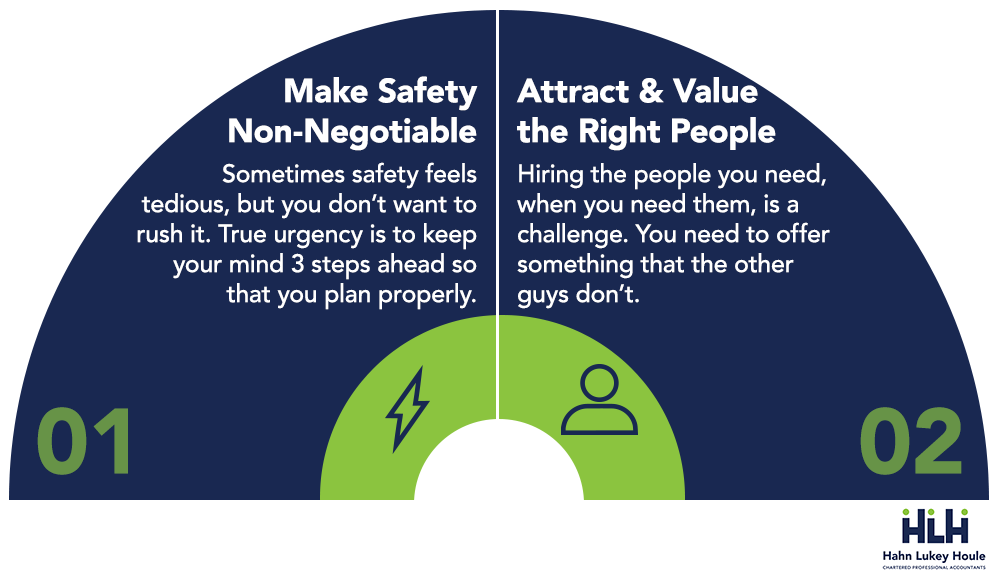
1) Make Safety Non-Negotiable

Anyone who has stepped onto a construction site knows it’s a dangerous place. Over thousands of years, and many lives lost, the construction industry has developed standards for negotiating hazards.

But sometimes safety feels tedious. You pay a person to clean every drop of every spill, to call someone else over to lift something they could probably lift themselves, and to make that second verbal check of the equipment. Yet you also know what can happen if you don’t spend the proper time or money…

Remember: urgency is not busyness. It’s not pressuring people to move faster. If you do that, your team’s “low-hanging fruit” for amping up speed will be to cut corners with safety protocols.

True urgency means helping your team see 3 steps ahead so that they plan properly. If everyone is only thinking about the next step and then the next, mistakes and inefficiencies will slip through unnoticed. Keep everyone thinking a few steps forward, and you’ll save time without endangering anyone’s life.


2) Attract, and Value, the Right People

Hiring the people you need when you need them is an industry-wide challenge. To get it right, you need to offer something that the other guys don’t. You build your marketing strategy to prospective clients around your key differentiators; same rules for attracting workers.

What are your hiring differentiators?

  • Paying more money?  This doesn’t necessarily attract the best people- just the opportunistic ones. And it can kill the bottom line like a bullet.
  • Reputation? We’re all envious of the companies that everyone wants to work for. But there’s a reason for it, and it’s probably not money.
  • Empowering culture? This is the one that matters. Empowering workplaces treat workers like skilled, smart adults. They foster accountability while encouraging people to make smart decisions independently.

A culture of urgency is a culture of listening. It’s a promise to listen backed by something more personal than a feedback form. It’s asking your workers what’s bugging them and making good on your share of the solution.

steps to urgency in construction

You can’t ask for urgency without showing it. If someone comes to you with an improvement that makes sense, it’s on you to show them the urgency of implementing the fix. The feeling they get when they see that their idea has a real difference in the business is the best retention tool you’ll ever have. Once your team sees the impact of their work, you’ll see what an internalized sense of true, healthy, urgency looks like.

Real and False Urgency in Manufacturing

Real and False Urgency in Manufacturing

real vs false urgency header

A culture of urgency is the fuel to drive Process Improvement forward. But when urgency breaks free of perspective, it becomes “busy-work”. And that can get dangerous on the shop floor.

If you’ve come any distance down the “Lean Road”, you know that your sense of vision is the best motivator for your team. It’s not the kind of vision that you summarize in an email memo. It’s the kind that you demonstrate, day in and day out, that inspires others to join you.

Vision creates perspective. Perspective is what keeps urgency from becoming dangerous. Here’s the difference between the 2 types of urgency:

  • False urgency needs this job done now and then the next job done now. It thinks about the next step and then the next. It doesn’t coordinate with others. In a Manufacturing setting, it can lead to people running down the stairs 2 steps at a time, cutting corners on safety protocols, and machines not being cleaned or serviced properly.
  • True urgency finds the horizon, and create a map as it charts backwards. It keeps perspective, knowing the goal is urgent but the task is not. It neither hustles nor bustles, but takes correct, coordinated steps, exactly when it needs to. True urgency understands that slowing down to keep things safe is the only way to achieve business goals.

real vs false urgency manufacturing

Here are a couple ways to keep your culture of efficiency as safe as it is productive:


1) Don’t Make Busy-Martyrs

How “busy” are your employees telling you they are? Are they wearing their busyness like a badge? When you ask about their task, do they throw how busy they are back at you?

Martyrs-of-busyness are only productive within their tiny sphere. They don’t collaborate with others, and that both brings down morale and creates costly silos between teams and departments.

Sometimes you need to slow people down in order for them to be more effective. That’s why production based KPIs like quotes are double-edged swords—if not managed properly, they lead to “busyness” and that makes people sloppy.

It’s up to the boss to create, or discourage, the culture where busy-martyrs thrive. That sense of inward-seeking, anxious busyness is the essence of false urgency. It leads to safety checks being skipped, spills not getting cleaned up, and accidents happening all over your business.


2) Dialogue with Your Team

An over-exuberant sense of urgency can be dangerous, but a healthy culture of urgency should improve your safety conditions.

Dialogue is like oxygen to process improvement.  Conversations, both formal in meetings and informal on the shop floor, are what keep the sense of urgency to keep improving alive.

Open the lines of communication and your employees will do more than offer ideas. They’ll point out potential hazards that you haven’t seen before. Not only will ongoing communication drive urgency forward: it will improve the safety of your business.

steps to urgency in manufacturing

In the manufacturing industry, quality output is vital to everyone who touches the organization—your team, your customers, and the business itself. Healthy urgency means accepting the challenge to deliver better. And that can’t be rushed.

Real and False Urgency

Real and False Urgency

real vs false urgencyComplacency kills businesses. The problem is that we know this. We’re so scared of complacency that we push our teams to stay busy. Complacency kills; busyness wounds.

Urgency is key. There are 2 kinds:

  • False urgency needs this job done now and then the next job done now. It thinks about the next step and then the next. It doesn’t coordinate with others. It trades aerial perspective for the perspective of those grinding away in the trenches.
  • True urgency finds the horizon, and create a map as it charts backwards. It keeps perspective, knowing the goal is urgent but the task is not. It neither hustles nor bustles, but takes correct, coordinated steps, exactly when it needs to.

True urgency is the fuel that drives Process Improvement forward. False urgency is false hope that drives your people into burnout.

false vs true urgency

3 steps to urgency

1) Listen

Stop measuring your day by hours. Start measuring it by focus. You always have more hours available than you have focus to make them productive. Choose wisely.

Listen to your team. How many times per day do they mention how busy they are? Do they list off what they need to do when you say “hi?” Do they wear their busyness like a badge of honour?

Keeping a business running smoothly is not checking off a list of errands. It’s giving your focus to the processes that matter the most.

Ask your team what was their 1 solid accomplishment that day. If they can’t think of one amid their errands-list of busyness, you need to slow them down so they can be more effective.


2) Look

Is your office a kicked-over anthill?  Are people scuttling this way and that way, each with their own task?

Pay attention. Are they working together like a symphony, or all tooting their own tune? Are they focused on one task at a time, or multi-tasking? Is one task happening well, or are 5 tasks happening poorly? Are they talking to each other? Passing tasks on like batons in constant collaboration? Or quiet and heads-down-busy?

Someone can look productive when they’re really looking for a stapler. See beyond the busy.


3) Ask

In order to run the business, you need to be present in it. Check in with your team, both in groups and one-on-one. Is your team thinking about the horizon, or are their eyes focused on the ground so they can take the next step? You won’t know unless you ask.

Process Improvement works when you tap into your business’ most valuable resource: its people. Buy them a coffee or walk with them in the hallway. Talk to them, and find out where their focus is.

If it seems they are solely focused on getting through some “To-Do” list, get curious. And start with yourself. Your fear of complacency may be rubbing off, so check in with the example you’re setting and make sure it is moving your team forward. Remember: false urgency only replaces complacency with waste, at your team and the organization’s expense.

Inspire them, don’t scare them. Show them where on the horizon you need to go, and then hand them a pencil to map it out together. Start to frame each task they do with the horizon in mind. Stop being busy, and start being visionary.

Creating a Sense of Urgency in Professional Services

Creating a Sense of Urgency in Professional Services

urgency in professional services


Successful process improvement needs to be cultural, and urgency must be at the cultural heart. Whether or not your entire team is driven towards process improvement will decide if your organizational change will succeed or fail.

Professional services businesses are close-knit teams. While having everyone under the same roof may get crowded sometimes, it also creates a deep sense of unity. You’re all in the same boat, and it’s that much easier to build a culture of urgency.

Here’s how:

urgency process in professional services

1) Daily Stand-Ups

Remember the meetings that are called with a deep sense of urgency, but by the time people wander in, pour a coffee and find a seat that urgency is gone?  It’s time to bring it back.

We often don’t realize some of the advantages our business models have. In professional services, everyone arrives to work at about the same time. It’s an opportunity to catch people before they get into their work and get them all on the same page.

Daily stand-up meetings will build a habit of urgency. The model is about energy and efficient communication designed to get people focused and on their way instead of ambling into their projects over 3 coffees.

Make it clear to the team that the stand-ups are reserved for announcing wins and losses, proposing solutions, and requesting help from other people on the team. When the team understands the utility of the stand-up, it becomes a tool for employee engagement and rapid change.


2) Identify Waste as a Group

Being there to listen to someone who tells you about waste is effective. But providing the space for people to assemble and identify waste together is powerful.

Hold a monthly or quarterly ‘efficiency’ meeting. Ask people to prepare by spending time beforehand thinking about waste (give them this time, don’t ask them to make it magically appear).

Conduct the meeting roundtable style with the bosses keeping their mouths shut. It’s the employees’ turn. Give them the chance to talk and they will, and what they say will save you money.


3) Inspire Them

Process improvement needs everyone’s engagement, but it needs your vision. Urgency comes from being inspired, and inspiration comes from leadership. It’s a common theme in process improvement and Lean that leading change can’t be done from the corner office; it happens in cubicles, hallways and lunchrooms.

Inspiration is more realistic than idealistic. Set actionable goals with timelines and accountability. Get everyone involved and move towards them together. Stay transparent about what parts of the plan are working what needs to be improved.


Make Sure Urgency is Productive

There are 2 kinds of urgency. There’s the running place-to-place, always-busy-never-focused, working-harder-but-not-smarter urgency. It’s unproductive, and in an office environment important details can get missed like that.

Productive urgency is being driven not to work faster, but smarter. It’s following the processes you’re used to, but opening your eyes to the waste that’s in plain sight.


productivity types professional services

Urgency goes hand-in-hand with a sense of ownership. Take the steps to involve your team today, and let them in on the impact their productivity is making on the business. When your team knows how much their contributions matter, a sense of urgency will naturally become a part of your business’s culture.


“I have been impressed with the urgency of doing. Knowing is not enough; we must apply. Being willing is not enough; we must do.”

Leonardo da Vinci

Creating a Sense of Urgency in Construction

Creating a Sense of Urgency in Construction

urgency in construction


Building a culture of urgency isn’t easy in the construction industry. For starters, your crews are remote and it’s usually up to your Foremen to convey that sense of culture.

There’s also safety. If you convey its importance wrong, your workers will equate urgency with speed, and accidents will follow.

You need a culture of urgency in order for sustained Process Improvement to work. Here’s how to do it in the construction industry:
urgency in construction process

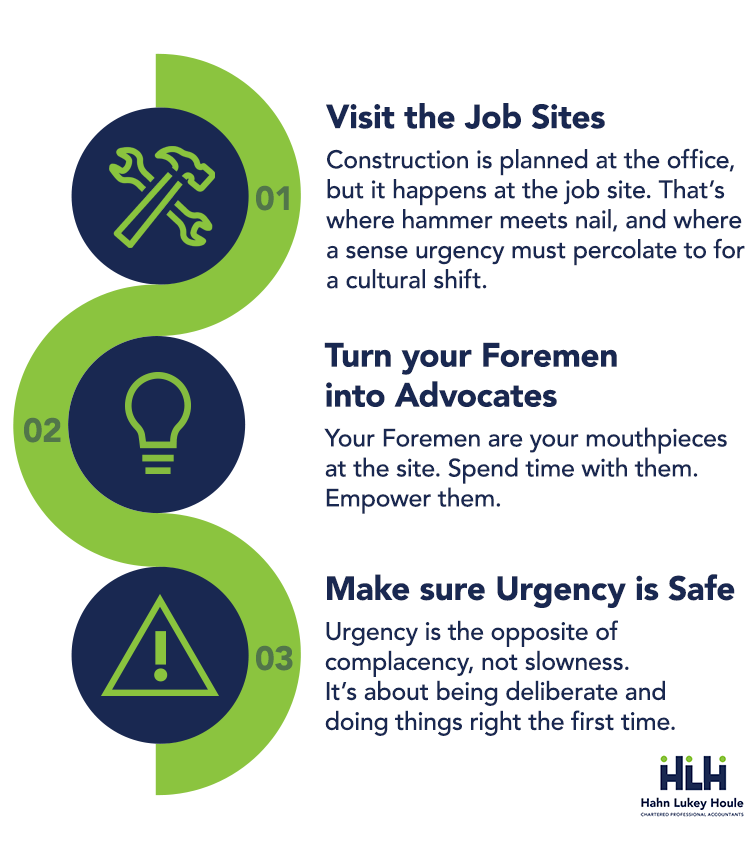
1) Visit the Job Sites

Construction is planned at the office, but it happens at the job site. That’s where hammer meets nail, and where a sense of urgency makes the biggest difference.

You probably visit your sites regularly anyway. Turn that up a notch. Get more face time with the teams working each job. Don’t commit to so many visits that it’s unsustainable in the long run, but make sure they see more of you.

Your presence on the job site will have a bigger impact than you might think. To start, your presence will bring a sense of urgency with it. Nothing like the captain on deck to make the crew snap to attention.

Your visit will also remind the workers that their job site matters. A reminder to take pride, double check their work, and get it done on time.

It’s also an opportunity to hear them. Gather them around and ask for their feedback. Catch up to them one on one, make an effort to get to know them, and ask about the small inefficiencies that bug them. Recharge them out of complacency and back into urgency.


2) Turn Your Foremen into Advocates

You can’t change your business’s culture from your office. You need boots on the ground, butts in the lunchroom seat, and eyes on the details.

You need to inspire. Giving employees the “how” of Process Improvement won’t do it. “How” comes later. Start with “why.” Tell them why this is so urgent for the business and get them on board (spoiler alert: if your “why” is to raise the bottom line 10%, find another one that involves the employees more directly).

Your Foremen are your mouthpieces at the site. Spend time with them. Empower them with what they can do. Give them permission to make the right call in the moment.

When they have feedback: listen. That is, actually listen and get back to them later with a follow up. Preaching Lean involves making good on needed process improvements. Give them ownership and make them advocates.

When foremen are empowered, they bring a sense of urgency back to the job site. Combine that with your more frequent visits and everyone will understand that you’re not only serious, more consistent.


3) Make Sure Urgency is Safe

There are 2 kinds of urgency. There’s the running place-to-place, always-busy-never-focused, working-harder-but-not-smarter urgency. It’s unproductive, and can even be dangerous in a construction environment.

Productive urgency is being driven to work smarter, not harder. Faster is dangerous. As you discourage reckless speed, remind people that it’s not necessary.

Urgency is the opposite of complacency, not slowness. It’s about doing things right the first time, and being deliberate in your actions. If anything, a culture of urgency in construction should make the site safer.


productivity types construction

Promoting a sense of urgency is really about promoting a sense of accountability. When people care, they care about getting the job done efficiently and properly. Once a team gets a sense of what they can achieve, that sense of urgency can evolve into a culture of excellence.


“I have been impressed with the urgency of doing. Knowing is not enough; we must apply. Being willing is not enough; we must do.”

Leonardo da Vinci

Creating a Sense of Urgency in Manufacturing

Creating a Sense of Urgency in Manufacturing

urgency in manufacturing

urgency in manufacturing processSuccessful process improvement needs to be cultural, and urgency must be at the cultural heart. Whether or not your entire team is driven towards process improvement will decide if your organizational change will succeed or fail.

Here’s how to build that culture of urgency:


1) Focus on Financials

Staff usually have no idea how profitable (or unprofitable) the business is. Chances are that they think you sleep on a pile of money.

Open up about the business. Tell them what areas are losing money and why. Make them understand how competitive your manufacturing environment really is.

Engaging your team is more than pep talks. It’s teaching them about the company they work for. They’re invested financially too – they pay the mortgage with this job. Trust them enough to tell them why process improvement is so important, and they’ll feel the urgency to help.


2) Identify Waste as a Group

Being there to listen to someone who tells you about waste is effective. But providing the space for people to assemble and identify waste together is powerful.

Create groups by department. Ask people to spend some time beforehand thinking about waste to prepare (give them this time, don’t ask them to make it magically appear).

Conduct the meeting roundtable style with the bosses keeping their mouths shut. It’s the employees’ turn. Give them the chance to talk and they will, and what they say will save you money.


3) Inspire Them

Process improvement needs everyone’s engagement, but it needs your vision. Urgency comes from being inspired, and inspiration comes from leadership. It’s a common theme in process improvement and Lean that leading change can’t be done from the corner office; it happens on the shop floor.

Inspiration is more realistic than idealistic. Set actionable goals with timelines and accountability. Get everyone involved and move towards them together. Stay transparent about what parts of the plan are working what needs to be improved.


Make Sure Urgency is Productive

There are 2 kinds of urgency. There’s the running place-to-place, always-busy-never-focused, working-harder-but-not-smarter urgency. It’s unproductive, even dangerous, especially in a manufacturing environment.

Productive urgency is being driven not to work faster, but smarter. It’s following the processes you’re used to, but opening your eyes to the waste that’s in plain sight.


two types of productivity

Creating a wide-scale sense of urgency can be a heavy lift in a process-based industry like manufacturing. With the process switch on, sometimes brains switch off. We need processes for efficiency and uniformity, but they can pave the way for complacency.


Urgency goes hand-in-hand with a sense of ownership. Take the steps to involve your team today, and let them in on the impact their productivity is making on the business. When your team knows how much their contributions matter, a sense of urgency will naturally become a part of your business’ culture.


“I have been impressed with the urgency of doing. Knowing is not enough; we must apply. Being willing is not enough; we must do.”

Leonardo da Vinci