Lean vs. Process Improvement: What’s the Difference?

Lean vs. Process Improvement: What’s the Difference?

The terms “Lean” and “Process Improvement” aren’t interchangeable. In fact, while they both seek bottom line savings, that’s where the similarities end. 

Here are some very broad strokes of what defines these tactics in relation to each other. Bottom line: their approaches feed off each other, and you’ll get better results with an integrated approach than a focus on one or the other.


Lean

This is the adaptable orthodoxy that started in manufacturing and has spread across industries. Its core focus is eliminating Kaizen (waste). 

Lean is an umbrella term for approaches to both cutting waste and (especially with manufacturing) increasing productivity.

Top-Down Approach

Eliminating waste is usually uncomfortable for front line workers. As such, the decision to “go lean” usually comes down from the corner office. 

If you’re a boss contemplating Lean, proceed with caution. It’s tempting (and easy) to cut waste by reducing staffing levels. You’ll get a short-lived bump to the bottom line and, for the next month or so, everything is roses.

But a top-down only approach is fraught with danger. Overworked staff will take unsafe short-cuts, grumble, break down morale, call in sick more often, and erode that cost savings in a host of other ways. 

Before you know it, you’re losing more money than you saved, and your staff are now resistant to Lean in general.

lean vs process improvement comparison table

Process Improvement

While Lean is a methodology, Process Improvement is a tactic. 

This focuses on the countless processes that happen daily in your business. It’s a proactive approach that investigates existing processes and improves upon them, often incrementally, in order to build efficiencies. 

When a process improvement is introduced, we all start out with the best of intentions. The key isn’t to stay excited about those great ideas—it’s to own them. Even after the novelty wears off.

Grassroots

You can’t improve processes without constant dialogue with the people who understand them best. That’s why the first step to Process Improvement is to get out of the office and onto the shop floor, to the front desk, or to the sites and ask your team what’s bugging them about how they do their jobs. 

This is grassroots. It’s listening to your staff about incremental, sustainable improvements. These aren’t the big cuts that come from staff changes; they’re small and meant to accumulate over time.

The side benefits of Process Improvement, which are often as valuable (or more) than the savings, are increased staff morale and engagement, as well as what you’ll learn from becoming more active in the trenches.

But this approach, done solo, is also dangerous. If the changes are all happening in a grassroots, decentralized way, they could end up actually adding costs to the bottom line. That’s why the “Lean big brother” needs to be monitoring and making the real financial decisions.


Better Together

Lean is a methodology of cutting waste with decisions coming from the boardroom. Process Improvement is a tactic of learning about how to make processes more efficient by talking to front line staff.

If cost savings were the diamond in the middle, these two are looking at it from totally different angles—but the common goal means they can work together to reduce waste without sacrificing morale, and improve processes without increasing costs.


“If you define the problem correctly, you almost have the solution.”

Steve Jobs

Creating a Change Team in Professional Services

Creating a Change Team in Professional Services

change team professional services hlh edmontonChange can come slowly to an office. Processes get ingrained, habits form, and the pressures of doing extra—on top of a long list of daily tasks—can quickly quell cooperation. 

Process Improvement can change the bottom line, but it needs to be systemic. Change that’s top-down tends to make deep changes that aren’t sustainable and fall apart when the momentum wears off. Morale often falls apart shortly thereafter.

System-wide change is bottom-up. It’s about everyone sharing the same vision and being committed to incremental change that is, above all, sustainable. You can’t force that—it has to come from your internal Change Team.

Here’s how to build that team.

best people process improvement professional hlh edmonton

Find Your Change Leaders

Small changes don’t happen by themselves, especially if they’re to be consistent. Your Change Leaders are the ones who, hour after hour, keep Process Improvement top of mind.

Your change team needs to be as all-in as you are. They need to be talking up the need to be nimble and efficient in the hallways, lunchrooms, and job sites. 

But how will you find them?

Think of your existing staff. They drive your company and know its inner workings better than anyone. 

Who are your most engaged employees? The ones already coming to you with ideas on how to do better. The ones who care, not because they have to, but because it’s their nature. 

Start with them. Then let them inspire others to the challenge.


Roles in Change Leadership


roles change leadershipPeople have unique strengths. Embrace them. Here are the roles your Change Leaders need to fill. Put them into the roles they’re passionate about and they’ll bring their daily A-game. 

Communicators: Don’t fool yourself – you’ll still have skeptics about this whole “Process Improvement thing” you’re up to. You need someone to not only share your vision, but articulate it with purpose when you’re not around. 

Advocates: Your skeptics will say they’ve heard this all before and swear it’ll fizzle soon enough. Change Leaders will need to be consistent about why change is vital and how to make it happen. Ideally, you’ll have an advocate at every step of your process.

Liaisons: Sustainable change is organizational. It affects employees and customers alike. No one likes surprises in business, so each group needs to be advised and guided through what is happening and how it benefits everyone. 

Coaches: Your team will need guidance and they’ll need to be challenged. Coaches do both. Coming from a peer, ongoing motivation is a powerful thing.

Resistance Managers: You’re going to get criticism. Rather than stifling it (which doesn’t end well), your Change Leaders can engage and respond constructively.


Empower Your Change Team

How many employees are driven every day to change your business for the better?  How many are doing the bare minimum until the end of their shift? And how many are somewhere in the middle? 

No one is going to be proactive about positive change unless you show them that the business is worth the investment of their energy. And that means investing in them first. 

Empowerment is a leap of faith. You need to give your employees the opportunity to contribute their perspective to the Process Improvement project. 


Not everyone will step up, and that’s normal. But give everyone the opportunity to be a part of a special initiative, and often your Change Team will come out of the woodwork organically. 


“Change is the law of life and those who look only to the past or present are sure to miss the future.”

 John F Kennedy

Creating a Change Team in Construction

Creating a Change Team in Construction

change team construction HLH edmonton

Staying profitable in the construction industry is about being able to adapt to change. Projects overrun, site conditions change, regulations close in: the businesses that stay nimble stay prosperous. 

Change management on a project-by-project scale is about building processes that both standardize best practices and anticipate changing conditions. Change management on a business-wide scale is no different.

To make your business more nimble and efficient, you need people to help you get there. You need a team dedicated to sustainable change.


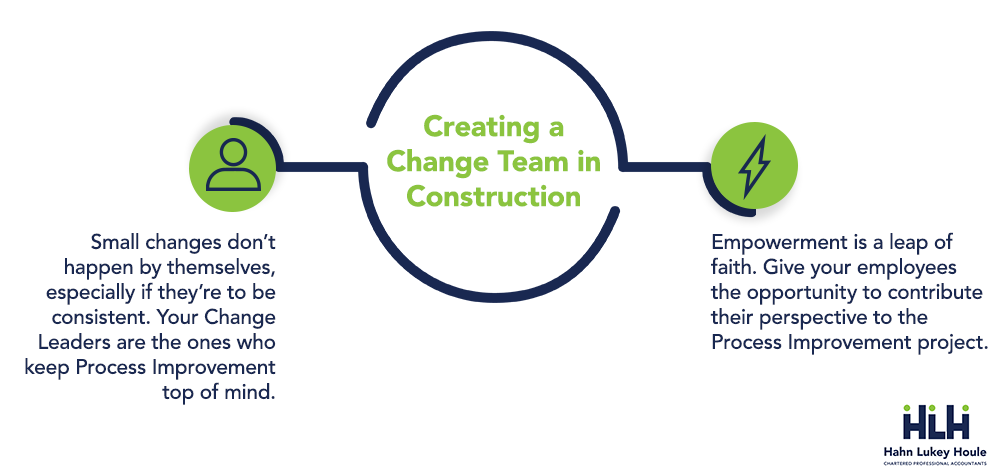
creating a change team in construction

Find Your Change Leaders

Small changes don’t happen by themselves, especially if they’re to be consistent. Your Change Leaders are the ones who, hour after hour, keep Process Improvement top of mind.

Your change team needs to be as all-in as you are. They need to be talking up the need to be nimble and efficient in the hallways and lunchrooms and job sites. 

But how to find them?

Think of your existing staff. They drive your company and know its inner workings better than anyone. 

So think: Who are your most engaged employees? The ones already coming to you with ideas on how to do better. The ones who care, not because they have to, but because it’s their nature. 

Start with them. And let them inspire others to the challenge.


Roles in Change Leadership


roles change leadershipPeople have unique strengths. Embrace them. Here are the roles your Change Leaders need to fill. Put them into the roles they’re passionate about and they’ll bring their daily A-game. 

Communicators: Don’t fool yourself – you still have skeptics about this whole “Process Improvement thing” you’re up to. You need someone to not only share your vision, but articulate it with purpose when you’re not around. 

Advocates: Your skeptics will say they’ve heard this all before and swear it’ll fizzle soon enough. Change Leaders will need to be consistent about why change is vital and how to make it happen. Ideally, you’ll have an advocate at every step of your process—from the office, to the floor, to the trucks. 

Liaisons: Sustainable change is organizational. It affects employees and customers alike. No one likes surprises in business, so each group needs to be advised and guided through what is happening and how it benefits everyone. 

Coaches: Your team will need guidance and they’ll need to be challenged. Coaches do both. Coming from a peer, ongoing motivation is a powerful thing.

Resistance Managers: You’re going to get criticism. Rather than stifling it (which doesn’t end well), your Change Leaders can engage and respond constructively.


Empower Your Change Team

How many employees are driven every day to change your business for the better?  How many are doing the bare minimum until the end of their shift? And how many are somewhere in the middle? 

No one is going to be proactive about positive change unless you show them that the business is worth the investment of their energy. And that means investing in them first. 

Empowerment is a leap of faith. You need to give your employees the opportunity to contribute their perspective to the Process Improvement project. 


Not everyone will step up, and that’s normal. But give everyone the opportunity to be a part of a special initiative, and often your Change Team will come out of the woodwork organically. 


“Change is the law of life and those who look only to the past or present are sure to miss the future.”

 John F Kennedy

Creating a Change Team in Manufacturing

Creating a Change Team in Manufacturing

You see the ways your manufacturing business could change for the better. You can sense it like a change in air pressure. You know that your processes could be more efficient, and that more innovation would help you buffer supply disruptions and skill deficits. To accomplish this, people are the key.

In theory, Process Improvement can save the manufacturing industry a ton of money and increase the bottom line. I say “in theory” because, without a Change Team in place, it can’t become reality. 

Your Change Team is the front line of Process Improvement. They articulate and implement your vision on the shop floor, in the lunch rooms, and even to your customers. You sense the change; they make it real. 

creating a change team in manufacturing

Find Your Change Leaders

Small changes don’t happen by themselves, especially if they’re to be consistent. Your Change Leaders are the ones who, hour after hour, keep Process Improvement top of mind.

Think of your existing staff. They drive your company and know its inner workings better than anyone. Hopefully, your Change Leaders are there. 

Who are your most engaged employees? The ones already coming to you with ideas on how to do better. The ones who care, not because they have to, but because it’s their nature. 

Start with them. And let them inspire others to the challenge.


Roles in Change Leadership


roles change leadershipPeople have unique strengths. Don’t be an obstacle to that; embrace it. Here are the roles your Change Leaders need to fill. Put them into the roles they’re passionate about and they’ll bring their daily A-game. 

Communicators: Don’t fool yourself – you still have skeptics about this whole “Process Improvement thing” you’re up to. You need someone to not only share your vision, but articulate it with purpose when you’re not around. 

Advocates: Your skeptics will say they’ve heard this all before and swear it’ll fizzle soon enough. Change Leaders will need to be consistent about why change is vital and how to make it happen. Ideally, you’ll have an advocate at every step of your process—from the office, to the floor, to the trucks. 

Liaisons: Sustainable change is organizational. It affects employees and customers alike. No one likes surprises in business, so each group needs to be advised and guided through what is happening and how it benefits everyone. 

Coaches: Your team will need guidance and they’ll need to be challenged. Coaches do both. Coming from a peer, ongoing motivation is a powerful thing.

Resistance Managers: You’re going to get criticism. Rather than stifling it (which doesn’t end well), your Change Leaders can engage and respond constructively.


Empower Your Change Team

How many employees are driven every day to change your business for the better?  How many are doing the bare minimum until the end of their shift? And how many are somewhere in the middle? 

No one is going to be proactive about positive change unless you show them that the business is worth the investment of their energy. And that means investing in them first. 

Empowerment is a leap of faith. You need to give your employees the opportunity to contribute their perspective to the Process Improvement project. 


Not everyone will step up, and that’s normal. But give everyone the opportunity to be a part of a special initiative, and often your Change Team will come out of the woodwork organically.


“Change is the law of life and those who look only to the past or present are sure to miss the future.”

 John F Kennedy

Finding the Best People for Process Improvement

Finding the Best People for Process Improvement

best people for process improvement


Any business, from Google to the hot dog cart guy, is defined by the people working in it. No matter how slick or strict your processes are, the people using them will adapt and (hopefully) improve them in their own image. 

It stands to reason, then, that you need the best people. You need people who won’t let any inefficiency escape without attacking it and rooting it out. You need an A-Team for Process Improvement. And that, of course, is the rub.

So how do you hire the people to get you there?  In another article we gave you some unique interview questions to try. Now, here are some outside-the-box tips to help get you there…

finding the best people steps

1) Listen to the People You Have

If you’re the Owner, I have some bad news for you. Statistically speaking, you probably make pretty terrible hiring decisions. 

You know what you need more than anything else. You also know how expensive it is every day that position isn’t filled. So, you look for the right stuff in the wrong people. You don’t think you do, but you do. You might ask leading questions or look for nuggets you only think are there. In short, it’s hard for an Owner to make a disinterested decision. 

If you want to be part of the interviews, have someone there with you whose opinion you genuinely trust. Create a script and stick to it, and keep those questions the same for everyone. Also, never hire without sleeping on it first.


2) Seek the Right Attributes

KASH box

If you haven’t heard of the KASH Box, look it up. Read our KASH box article for the details, but here’s the summary. You hire on 4 qualities:

  • K – knowledge. What they know coming in.
  • A – attitude. Their perspective on life.
  • S – skills. What they can do coming in.
  • H – habits. How they live their lives.

K and S are easy to test, ask questions about, and hire on. It’s appealing to be able to bring a front-end loader operator on day 1 and they’re rocking. And for many jobs – the jobs that require specific and detailed day 1 skill sets, K and S are key.

A and H are harder to unearth. It’s more than their words, it’s also how they respond to your questions. 

You’re not trying to measure how well they’ll perform a process anymore. You’re measuring what they will do when they see a potential improvement for the process. Will they let it slide and just keep doing their job, or will they tackle it, mentally wrestle with it, and come to you with a potential fix?

If you want someone to be good at their job on day 1, hire for Skills and Knowledge. If you want them to grow into their job over time, and help you grow your business with you as they get to know the inner workings better, hire for Attitude and Habits. 

Ultimately, you can train any skill you need. But you can’t train habits, nor can you train attitude. 


Remember that every new hire has the potential to be with you for a long time—for better or worse. The right people aren’t just capable. They care about being a real part of your business’ success.

Real and False Urgency in Professional Services

Real and False Urgency in Professional Services

real vs false urgency professional services

When complacency sets root in an office environment, it’s hard to dig out. No amount of stern emails or strongly worded memos will give your team a sense of urgency. Only a culture of Process Improvement will do that.

Forcing your team to rush isn’t healthy urgency. It does far more harm than good. Before you know it, corners are cut on quality control, key meetings are cut short, and client-losing mistakes start to happen.

Here are the 2 kinds of urgency:

  • False urgency needs this job done now and then the next job done now. It thinks about the next step and then the next. It doesn’t coordinate with others. It trades aerial perspective for the perspective of those grinding away in the trenches.
  • True urgency finds the horizon, and create a map as it charts backwards. It keeps perspective, knowing the goal is urgent but the task is not. It neither hustles nor bustles, but takes correct, coordinated steps, exactly when it needs to.

real vs false urgency professional service

True urgency is the fuel that drives Process Improvement forward. False urgency is the fast, easy, and costly path that drives your people into burnout. 

So how can you create the right culture of urgency?  It’s about differentiating good “busy” from bad “busy”, and attracting the people who believe in Process Improvement.


1) Create the Right Kind of “Busy”

Stop measuring your day by hours. Start measuring it by focus. You always have more hours available than you have focus to make them productive. Choose wisely. 

Listen to your team. How many times per day do they mention how busy they are? Do they list off what they need to do when you say “hi?” Do they wear their busyness like a badge of honour?

Keeping a business running smoothly is not checking off a list of errands. It’s giving your focus to the processes that matter the most. 

Ask your team what was their 1 solid accomplishment that day. If they can’t think of one amid their errands-list of busyness, you need to slow them down so they can be more effective. 


2) Attract the Best People

Hiring the people you need, when you need them, is a challenge in every industry. To meet and defeat the challenge, you need to offer something that the other guys don’t. You build your marketing strategy to prospective Clients around your key differentiators; same rules for attracting quality staff: 

What are your hiring differentiators?

  • Paying more money?  This doesn’t necessarily attract the best people- just the opportunistic ones. And it can kill the bottom line like a bullet.
  • Reputation? We’re all envious of the companies that everyone wants to work for. But there’s a reason for it, and it’s probably not money.
  • Empowering culture? This is the one that matters. Empowering workplaces treat workers like skilled, smart adults. They foster accountability while encouraging people to make smart decisions independently.

A culture of urgency is a culture of listening. It’s a promise to listen, and then backing that up with something more personal than a feedback form. It’s asking your team what’s bugging them, and making good on your share of the solution. 

steps to urgency professional service

At the heart of it, creating healthy urgency is about encouraging employee engagement. The goal isn’t to “get there” faster, it’s about generating momentum as a team. Rather than letting complacency set in, you can create a dynamic in which accomplishments are shared and celebrated by everyone.